Showing posts with label city tour of Belgrade. Show all posts

Visit four Fortress in Serbia, all on the Danube River

Petrovadin Fortress, known for its “reverse clock” with the longer hand showing the hours instead of minutes in order to help local fisherman to see the time from a distance, is located on the Danube River, in Novi Sad. The construction of the Fortress was started in 1692 by Charles Eugene de Croy, a field marshal who fought against the Ottoman Turks in their attack on Belgrade.
The first mention of a fortress on this spot was made by the Romans who made a military base to protect their eastern borders. When King Bella IV of Hungary brought over the French monks who had built Belakut Monastery on the ruins of a Roman military camp, the whole area changed dramatically. The monastery was built between 1247 and 1252 and was “live” until the Middle Ages. Today’s look of Petrovardin Fortress dates from 1687 when the Austrian Army captured the fortress after 150 years of Ottoman occupations. The fortress is well known for its complicated system of underground tunnels, spread over four levels and 16000 meters long.
You can visit Petrovardin Fortress on a day tour from Belgrade or from a cruise on the Danube River.
Petrovardin Fortress, Cruise on the Danube River in Serbia, ReadyClickAndGo
Cruising on the Danube River your next stop is going to be in Belgrade at Kalemegdan Fortress orBelgrade Fortress situated at the confluence of the Sava and Danube Rivers and it’s divided into a park and fortress. Originally the fortress was a military compound established by the Romans to defend its eastern borders from the barbarians. Easy accessibility by rivers made the military compound grow into very important city, Singidunum, on the crossroads between east and west, and today known as Belgrade. As a result Kalemegdan Fortress is full of historic monuments spanning the centuries. The Roman influence is easily visible at the entry to the Fortress, in the basement of City Library where Roman water pipes were discovered during refurbishment. The first Serbian church, St Ruzica,  is located within the fortress. Within the park you can see the Turbe (Tomb) of Damad Ali Pasha, one of the few well-preserved monuments of Islamic culture in Belgrade, and the military shelter built by the Austrians during their occupation of Belgrade in 1718, called locally Barutana (Gunpowder).
The Victor, a monument is dedicated to victories in WWI is located on the main plateau and it’s a work by the famous Croatian sculptor Ivan Mestorovic. Behind the monument in the greenery of the park there is bunker from WWII in used as late as 1997.
Walking through Kalemegdan Fortress is like walking through history. Unfortunately the Fortress was refused UNESCO World Heritage status as there is a military establishment in use on the site – the Military Museum.
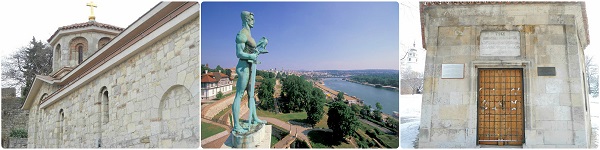
Belgrade Fortress, Cruise on the Danube river in Serbia, ReadyClickAndGo
Continue cruising downstream on the Danube River and visit Smederevo Fortress the best preserved building of medieval Serbia, built between 1427 and 1430 by the Despot Djuradj Branakovic. The fortress is surrounded by water on three sides – from the Danube River on one side, the Jezeva River on another, and on the third by a canal across the promontory. All along the edge of the fortress high bastioned walls were erected every 200 feet. The northern part of the fortress is the Little Forte which was home to Djordje and his wife and where the wall of great hall still stands, the windows still look across the Danube towards Hungary. The Forte was the second line of defence behind the moat with four richly decorated bastions. One of them is engraved with a cross and the year 6938 which is the year of the beginning of the world according to Greek Orthodoxy.
The fortress was badly damaged during WWII from bombing by the Allies and an explosion in the ammunition store used by the Germans. Smedervo Fortress may lack the splendour of the Petrovardin and Kalemegdan Fortresses but its history makes it up for it. Today the Fortress is used for festivals and concerts which take place within the inner part of the fortress where a stage was built.
If you have time I would suggest you cross the train track (Smederevo Train Station is adjacent to the fortress’s southern walls) and visit Smederevo Museum which is very rich in local history dating back to the Roman period.
Smederevo Fortress, Cruise in Serbia, ReadyClickAndGo
Further downstream on the border with Romania there is another gem of a fortress called Golubac which is strategically located where the Danube River is at its narrowest and forms the so-called Iron Gate Gorge. Again, the first mention of Golubac Fortress dates back to the Roman era when there was a military site. Golubac Fortress was a border between different empires, the Turkish, Hungarian, Serb and Austrian, and as such was witness to many battles. It changed hands regularly until 1867 when it was given to the Serbs.
Golubac Fortress consists of 10 towers which are 20 -25 m high. Some of the towers are in good condition, others lack some walls. The last time I visited was in 2009, and Golubac Fortress, although it attracts lots of tourists and there was a project to restore it to its former glory, is still undeveloped. If you have time try to reach the towers in the upper compound which is the oldest part of the fortress. The oldest tower, tower number 1, is situated here and it’s called Sesir Kula or Hat Tower and you can see the Serbian church inside. Also the views over the Danube River are amazing from here.
Golubac Fortress is reachable on a day tour from Belgrade. If you decide to drive to the Fortress visitViminicium, another Roman base, and the Silver Lake were you can stop for a nice lunch.
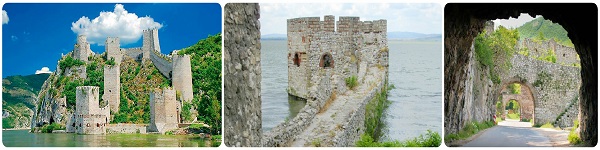
Golubac Fortress, Cruise on the Danube River in Serbia, ReadyClickAndG
If you are travelling to Serbia and would like to visit any of the Fortress listed here ReadyClickAndGo can offer customised day trips with your own guide, car and driver Private day trips throughout Balkans and Asia are also available, visit www.ReadyClickAndGo.com or email Tara@ReadyClickAndGo.com 

Museum on Steroids - Museum of Orthodox Church of Serbia

Things to see and do in Belgrade, Visit the Museum of Orthodox Church of Serbia with ReadyClickAndGo


Over the years, the route became a habit – every time I walked down from Knez Mihailova Street towards the Kosancicev venac , I would stop at the Patriarchal Palace and ask to visit the Museum of the Orthodox Church of Serbia, And every time I would get the same reply: “The museum is under construction, reconstruction or it is closed.”  Being an insecure person, I began to think that there was something wrong with me, my dress code, my thirst for a cold beer, for good food and all the things the church says to refrain from.

A few days ago I tried my routine again and a man dressed in a crisp business suite rather than a priest’s robe declared in an authoritative voice “The Museum is open…You need to enter from the door opposite St Michael’s Cathedral.“ Without saying thank you I ran off to the other side of the same building and excitedly pressed a heavy door, pushing it with my whole body and almost falling into what was a garage once upon a time and today was a well-polished entrance hall still smelling of paint. The floor was set in three different colours of marble with distinctive artwork in the shape of circles, something you find in Serbian churches built nowadays. After purchasing a ticket we walked towards the heavy stairs that led us to the museum itself  on the first floor.  The first impression was disappointing. It was a long hall decorated with framed letters, notifications, portraits of church dignitaries, and old photographs from Serbia’s rich past. We walked through very quickly thinking, is that it? At the end of the corridor a lady, dressed in blue, maybe a uniform, walked in front of us and disappeared into a room on the right.  I heard her unlocking the door, switching the lights on and her rubber shoes squeaking through the empty building, she disappeared where she came from. Dispirited and ready to go back we secretly peeked through the door where the lights came from and we stood silent, shocked with the amount of the history laid bare in front of us.  The loud and honest “WOW” made a lady who opened a door chuckle behind us.  Adrenalin and frustration at not being to see the Museum for such a long time kicked in and I started running around trying to see everything at once. Then realising the Museum is not that big only very rich with exhibits I calmed down and started to follow some kind of pattern.
Liturgical books decorated in gold, silver and precious stones dating back from XIV century, the shroud of King Milutin dating from end XIII or beginning XIV c, a silver reliquaries chest dating from XVI c, the sermons of St Isaac of Syria, XIV c, a huge icon of wood, the Adoration of the Wise Men from XVII c, Byzantium crosses and seals, chalices, old sacred vessels, various donations, icons, are squeezed into three connected rooms. Each display had an explanation written in Serbian and English showing the development of the Serbian Orthodox Church through the centuries.  Most of the exhibits come from monasteries scattered around Fruska Gora, from churches around eastern Srem and from donations.
Textiles have a significant presence in the museum and two very interesting pieces of history are the gown of  Prince Lazar dating back to 1389 which is the year of the battle of Kosovo, and a shroud made by the nun Jefimija who is regarded as the first Serbian poetess.
The Museum and the richness of the exhibits are of the standard of the exhibition held in London at the Royal Academy of Art, titled Byzantium. The only difference is that you don’t have to queue here in Belgrade and the entry tickets are much more affordable.  This may change as the Museum of the Orthodox Church of Serbia is just recently opened.
Address: Kralja Petra  nr. 5, entrance from the street Kneza Sime Markovica 6
Open: Weekdays 9-16h, Saturdays, Sundays and Religious Holidays the Museum is Closed
Entrance fee: RSD400 (approx US$5 as per 20th January 2014).
For more information about things to see and do in Belgrade of independent day tours in Belgrade please email Tara@ReadyClickAndGo.com or visit specialist website for day tours, day trips, city tours, travel experiences at www.ReadyClickAndGo.com

Using Public Transport in Belgrade

day tours in Belgrade, Serbia, ReadyClickAndGo

I don't consider myself pretty but I do like it when people look at me. I don’t know any female who doesn’t! Deep down I wish I was an actress on the stage and have all eyes heavily focusing on me…Yes that is what I would secretly love and that is what I get when getting on public transport in Belgrade. Well when you say public transport you will probably think of the tube or metro but in Belgrade public transport has aggressive OAPs, beggars, Roma musicians, dirt-encrusted windows and ordinary citizens. There are trams and some electric buses but the same adjectives could be used for any of them.
My travelling starts from the bus stop in front of the Palace of Serbia in New Belgrade where I take the number 16 to Old Belgrade just across the Danube River. I may take the bus at different times of the day or week as I am working from home and am not bounded by regular office hours. What I have realised is that:
-       Instructions on how to use BusPlus tickets are written in Cyrillic letters which is the official alphabet of Serbia. There is no explanation in English or any other language so if you decide to use public transport in Belgrade start learning the Serbian alphabet and good luck!
-       Buses are frequent and always full.
-       I never saw disabled person in a wheelchair on public transport in Belgrade.
-       There is never ever an empty seat.
-       If there is empty seat, an OAP will grab it, even though they are on two different sides of the bus.
-       Ticket validation is 21st century while service is in the middle ages. Drivers are underpaid, (sounds familiar?) overworked and some vehicles should be sold for scrap metal, not on the road.
-       People stare at you, intensely, when you enter the bus.
This last remark used to puzzle me and I was always under the impression that the staring was due to my fresh faced looks, my hair style, my coat, bag… I never had so many glances on entering a bus in any part of the world.
day tours in Belgrade, Serbia, ReadyClickAndGo
Last night I went out with a friend, a local lad, one of few who decided to stay in Belgrade and try to make something of this interesting city.
His first comment on entering the bus was “Don’t validate your ticket. People don’t. The price is too high for the service you get! ”
“What if an inspector comes to check tickets?”
“Just tell them that you will get off at the next stop”
“But…”
“Don’t but – look around you. Most people don’t validate tickets. They all stare at people getting on the bus in case they are the inspector.”
My dream of the stage and me as a famous actress disappeared at the next bus stop.