Showing posts with label ReadyClickAndGo. Show all posts

Zica Monastery

Visit to the Zica Monastery, Serbia, ReadyClickAndGo
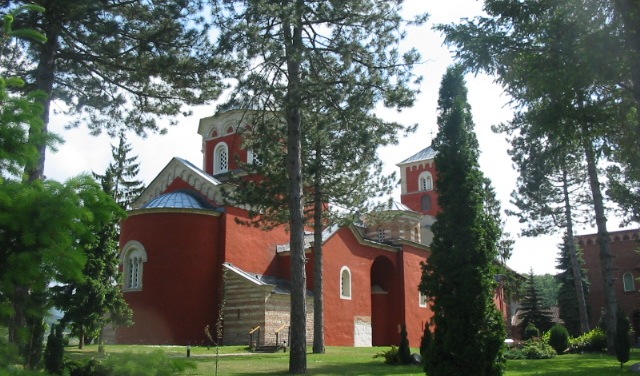
Zica Monastery is situated around 25 km outside of Vrnjacka Banja which is in central Serbia, 200 km south from Belgrade and the Monastery is an endowment of King Stefan the First Crowned and built between 1190 and 1124.  Zica was the first seat of the autonomous Serbian Archbishops and it was there that 7 Serbian kings were crowned, the latest one King of Yugoslavia. It is painted in red – Serbian Royal colour. The most significant composition is formed by the latest frescoes painted between 1309 and 1316. Nearly nothing has been saved from the once rich monastery treasury except the holy relict – right arm of St. John the Forerunner laid in silver, which was brought to the monastery by St. Sava. Today the holy relic is preserved in St. Mary’s Cathedral in Sienna. The Monastery was heavily bombed during WWII by Germans and set on fire during their occupation. Today is a women’s monastery and there is only one fifth of frescos left from original work. The nuns support themselves by working on land, making teas and honey which they are selling. Worship takes place very day at 5 pm and I would recommend it to anyone. Singing is beautiful and acoustic in the church is very good. The whole atmosphere is mystified by closing entry doors and old ritual by nuns at the end of pray.
How to get to the Monastery Zica:
By bus from Belgrade to Vrnjacka Banja then by local bus. You will have to stay overnight in Vrnjacka Banja. Or pre book a full day private tour with car, driver and local guide to the Monastery Zica from Belgrade with ReadyClickAndGo.  For more information please email tara@ReadyClickAndGo.com

Visit Belgrade Fortress

Free Things to do in Belgarde, Visit Belgrade Fortress,  ReadyClickAndGo
History of Belgrade Fortress
Present-day Belgrade and its must-see fortress are located on the right bank of River Sava and was originally established as a Roman military camp to protect its eastern borders from the Barbarians. The IV legion, Flaviae, were based here and as they were often victorious they were nicknamed the ‘lucky’ legion. In the 2nd century AD the settlement around the camp was granted municipality status which meant that its inhabitants enjoyed the same rights as all Roman citizens. When the Roman Empire was divided into West and East, Singidunum become a part of the Eastern Roman Empire, Byzantium, and become known as Singidon.
Viist Kalemegdan Fortress, ReadyClickAndGoWhen Attila the Hun conquered the Balkan Peninsula, he destroyed everything in front of him including Singidon. The local guides in Belgrade say that Attila the Hun was buried at the confluence of the Sava and Danube just below Belgrade fortress. But if you go to Szeged, a charming Hungarian town, the local guides say the same.
The Roman Emperor Justinian I, realising the importance of the border town, ordered the re-building of Singidon to make it strong and impenetrable. An influx of Slovene immigrants from Russia moved into the city  and called it Belgrade, the White City, due to the white stone the city was built from.
Belgrade became the capital of the Serbian state in 1404 and the ruler, known as the Despot, rebuilt the fort.  Mehmed II, ruler of the Turkish Ottomans, attacked Belgrade three times and the city became known as “Antemurale Christianitatis”, the defender of Christianity.
Turbe, belgrade fortress, readyclickandgoThe Turks finally conquered Belgrade in 1521 and made it a strong military base for future military raids into Western Europe. The fortress was renamed Kalemegdan, (kale – city and megdan – field) and you can still see two remaining Ottoman constructions, the first being the fountain of Mehmed Pasha Sokolovic in the lower town, the other the tomb of Damad Ali Pasha situated in the upper town.
Over the next few centuries Kalemegdan Fortress shuttles between Austrian and Turkish occupation, and you can still see traces of both on the walls of the fortress. The Turkish used a rough white rock and stuck it in the walls while the Austrians used red bricks which are visible in the lower part of the fortress, especially around the powder magazine built by them during their occupation from 1717 to 1739. During the 1990s the area was leased to entrepreneurs who turned it into a night club. Since then the government has realised the importance of the place and made it into a museum. Today it’s a nice exhibition area hosting the National Museum’s Collection of Stone Monuments. This rich display is gathered from different part of Serbia and consists of Roman sarcophagi, gravestones and altars.
Roman Well, vISIT Belgrade Fortress, ReadyClickAndGOOne of the constructions left by the Austrians is a well which most people think was built by the Romans. The architecture of the well is typically Austrian who used red bricks, and its original function was probably to make a silo or water tank for army supplies. The presence of the water in the well led many to believe that its construction could have been connected to the Sava River but research in 1940 disproved the idea.  To visit the Roman Well you need to pay a token entrance fee.
Another Austrian structure is Clock Tower build above the Clock Gate. When the Austrians occupied Belgrade they decided to move the clock gate few meters to the right and at a certain angle in order to defend the town more effectively. Today you can see the difference in building materials used by Austrian and Turkish architects by looking at this gate.
What to See at Belgrade Fortress
Zindan Gate, Visit Belgrade Fortress, ReadyClickAndGoThe fortress is divided into four parts which are interconnecting through 18 gates. The most famous and the most photographed site of Belgrade is Zindan Gate located between the Despot and Leopold Gates. It’s easily recognised as it lies between two towers which were used as dungeons, zindan in Turkish.
From Zindan Gate you can easily walk towards the Lower Town of Belgrade Fortress and visit two Orthodox churches, St Ruzica and St Petka. The St Ruzica church bells were created from the melted down bronze statue of Archduke Franz Ferdinand which was supposed to be erected at today’s Monument of Gratitude to France in Kalemegdan Park. When Gavrilo Princip killed the Archduke in Sarajevo the Serbian Government decided to melt down the bronze and use it for the church bells. Today Serbians joke that you can still hear the Archduke over Belgrade!
St Petka Church is worth a visit as the interiors are lined with colourful modern mosaics – try to avoid Fridays which is the saint’s day and the church is packed. The entrance is free.
From the platform outside St Petka Church you can see the dilapidated Charles VI Gate and refurbished Nebojsa Tower. It looks very close by and you can certainly walk and visit it but getting back can be tough as you have to walk uphill. Also you need to pay an entrance fee for the Nebojsa Tower which is not good value for money. The exhibition is a combination of historical facts and technology.
Visit Belgrade Fortress, ReadyClickAndGoFrom the Lower Town you can walk back through the Zidan and Despot Gates, passing the Belgrade Planetarium on your right which used to be a hamam. In front of it you can see the upper section of the fortress with beautiful views of the confluence of the Sava and Danube Rivers. On the main plateau there is a tall statue of Victor. The original idea was to have it in the city centre but because of his nakedness which could shock the female population, the city planners decided to have him here instead. He is holding a falcon in the left hand and a sword in the right. It’s a work by the famous Croatian sculptor Ivan Mestrovic and is dedicated to victories in WWI.
Behind the Victor’s back there is a small hill covered with trees but you have to look carefully to notice the hill. It’s a very interesting place as it’s a bunker from WWII which was used until 1990. You may notice the small, heavy, rusty doors which are locked. In order to visit the bunker you need to book a licensed guide. We visited and wouldn’t recommend it to anyone claustrophobic. According to records which were opened recently, the Yugoslav army was stationed here, secretly, soldiers on a two-month-on, two-month-off basis. The question is, how did they manage to sneak into the bunkers unnoticed next to the most touristy area of Belgrade without anyone noticing? Old Belgraders remember that this area was closed off every two months for ‘renovations’ but in reality it was closed off for the army and supplies to get into the bunkers.
Visit Military Museum in Belgrade, ReadyClickAndGo
If you have time I would suggest you visit the Military Museum which is situated in Kalemegdan Park. The largest exhibition area is dedicated to WWI and “glorious” WWII when Serbia was one of the few countries fighting the fascists.  You need to pay an entrance fee but it’s worth visiting.
Opposite the Clock Gate is a house which used to be a watch tower, then Mason headquarters and today is used as an exhibition space. The National Museum has been closed for renovations for the last 20 years but they haven’t started yet and as a result there are lots of good exhibitions around the city, including in this building. You can have a short and pleasant stopover here. You have to pay an entrance fee but its well worth it.
If you decide to exit Belgrade Fortress by turning left from here and walking along the basketball polygon you come to Belgrade Zoo.  If you decide to turn right you will come across the imposing Monument of Gratitude to France who helped the Serbian Army during WWI, and then into the famous Knez Mihailova Street.
St Ruzica Churhc at Belgrade Fortress with ReadyClickAndGoAnd to round up the whole history of Belgrade Fortress we suggest you visit the City Library on the right side of Knez Mihailova Street. The building used to be the most famous hotel in Belgrade, the Serbian Crown, which was due to be converted into the city library. Architects dug out the basement only to find the foundations of a wall and tower of the main city gate from Roman times, part of the northern defences of the 2nd or 3rd century BC, and around which the settlement of Signidunum (present-day Belgrade) grew.  There is a small collection of sculptures, altars and gravestones in the Roman Hall but what is most fascinating is the water pipe which transferred water 10 km away. It is said that when the Ottomans (the present-day Turks) occupied Belgrade and found the pipes they decided to gather all the workers who were working on maintenance and take them back to Constantinople, (present-day Istanbul) to maintain their Roman water pipes.
Kalemegdan Park at Belgrade Fortress, ReadyClickAndGoThe most asked question we get is about the opening times of Belgrade Fortress.  Belgrade Fortress is a combination of monuments of historical importance, museums, places of interest, religious buildings and parks. You can enter Belgrade Fortress any time of day but you won’t be able to visit the Military Museum at 8 pm or go to the Church of St Petka. You would be able to walk around the Belgrade Fortress and take night photos of the confluence of the Sava and Danube Rivers. Opening times of each place at Belgrade Fortress are different and you better check them before visit.
Belgrade Fortress is a timeless piece of history, important not just for Serbian but European history too. It certainly deserves to be a UNESCO World Heritage Site!
For a private guided tour of Belgrade Fortress please email Tara@ReadyClickAndGo.com

St Sava Church - The Hagia Sofia of the Balkans

St Sava Church, Belgrade, ReadyClickAndGo
The photographic icon of Belgrade is St Sava Temple which is still a “work in progress.” Its position, on the grounds of Vracar where the relics of Serbia’s first Archbishop, St Sava, were burned by the Ottoman Turks in the 16th century, is very impressive and is visible from every corner of the city.
The church is built in the Byzantium style with the figure of the cross forming its base and a large central dome above and four semi-domes lower down, with galleries all around supported by an arcade underneath.
Does that sound familiar?
You might have seen this construction somewhere else in Europe?
St Sava vs Haga Sofia ReadyClickAndGo
If you have visited Istanbul and the magnificent Hagia Sofia then you’ll spot its resemblance to St Sava Temple.  Istanbul (once known as Constantinople) was established by the Roman Emperor Constantin (born in Serbia) who decreed that Christianity be the main religion of the Roman Empire. Constantinople, or the New Rome, became the capital of the Byzantine Empire and today the Hagia Sophia is the best surviving example of Byzantine architecture.
St Sava Temple is the largest working Orthodox temple in the world. Is it going to surpass and overshadow the Hagia Sophia in Istanbul? Time will tell.
Haga Sofia of Balkans, St Sava Church, Belgrade, ReadyClickAndGo
        For more information about travelling to Belgrade please email Tara@ReadyClickAndGo.com

The smallest church in the world?

by Olivera Milic. Conservationist and restorer, guardian of cultural heritage in her city and her country.
The smallest church in the World, ReadyClickAndGo
In the mid-17th century, a tiny church was built in Doinovici village, near Novi Pazar in Serbia. The church, better known as Marinica, is 2.5m x 1.5m (barely 4sq/m) and is thought to be the smallest church in the world.
Legend says:
“The pasha of Novi Pazar had long prohibited the natives to have their own temple. The natives were, however, persistent in their demands and in the mid 17th century a compromise was reached. Pasha finally allowed them to build a church, but gave them three tough conditions: the church had to be located on one of the hard to access spots, it had to be small and it had to be built in one night between dusk and dawn.”
The smallest church in the world, ReadyClickAndGo
This is how the Pasha wanted to prevent believers meeting in church in large numbers, so as not to plot against Turkish authority. However, they fulfilled all three conditions and Marinica was built in just one night, under the careful surveillance of the Pasha’s dignitaries. And today it’s a rare historic gem of a place with a great story and beautiful frescos!
It’s certainly the smallest church in Serbia – but is it the smallest church in the world? Let us know.

Visit the Princess Ljubica Residence in Belgrade

Visit the Princess Ljubica Residence in Belgrade, ReadyClickAndGo

Soak up the atmosphere of a unique historic house in the heart of Belgrade, one that perfectly reflects the duality of traditional Ottoman and 19th century European influences that battled for supremacy in Serbia at that time.
The Princess’s Residence was built in 1831 for Princess Ljubica who was the wife of the first Prince of Serbia, Milos Obrenovic, who secured Serbia’s independence from the Ottomans. The house is located in the heart of Belgrade squeezed between St. Michael’s Cathedral, the Patrichast and the oldest kafana in Belgrade. The front garden is large and the position is such that the house would have had a beautiful view of the confluence of the Danube and Sava from its back garden. The architecture is a mishmash of traditional Ottoman style and then modern European neo-baroque, Napoleon III and Altdeutch styles.
Princess Ljubica Residence, Belgrade, ReadyClickAndGoMy feeling is that the rooms of the Residence were used according to the guests – if someone very European-orientated entered the house then they would be taken to some of the many European style rooms, decorated with oval wooden tables and comfortable hand made chairs where afternoon tea would be served, while anyone with a Turkish background would be taken to the main lounge set in the typical Ottoman style with wooden benches covered in thick, soft velvet and served Turkish coffee with rahtluk (Turkish delight). A clever arrangement as Serbia wasn’t yet totally free of Turkish claws but was desperate to be seen as European.
There are ground and first floor set in the same layout with the size of the rooms the same on both floors. The present-day ticket office used to be a waiting room for visitors. From there you are led into a spacious lounge which is in a typical Ottoman style. The room on the left is set in the European style and has a small en-suite bathroom which was very modern at that time in Serbia.
This room is connected to one of the best preserved hammans in Belgrade which leads me to believe this part of the house was the Rooms at the Princess Ljubica Residence, Belgrade, ReadyClickAndGoprincess’s private quarters, but today the room looks like a modern European meeting room. On the wall you can see portraits of the Obrenovic family and the most interesting one is of Milos Obrenovic, the first Prince of Serbia, with a medal depicting the head of the Sultan, signifying that Serbia was still part of the Ottoman Empire.
Opposite the lounge in the right-hand corner is a room set in the Turkish style covered in hand-made carpets and wooden benches set below big windows opposite the entrance. There are wardrobes which were used to store bedding and linen. Strangely enough there are no bedrooms because they apparently slept on the floor.
On the right side of the main lounge or divan there is another room in the typical Turkish style, minimalist, with lots of benches along the main wall, and woodwork decorated with shells, and a Turkish smoking pipe. The walls are bare, there are no portraits or mirrors. The middle of the room is empty except for the big thick carpet. It seems like another meeting room but a bit more exotic.
Rooms at the Princess Ljubica Residence, Belgrade, ReadyClickAndGoIn the left corner of the house there are two rooms which appear to be the private family quarters where less formal meetings would take place. To get to the first floor you have to walk up the best preserved wooden staircase in Belgrade, with wide, carved treads.
The first floor is the same as the ground floor – a mix of different styles and with rooms in the the same position as on the ground floor. There is a big basement too which is used by the National Museum to host some of their many exhibitions. They are free to visit.
Princess Ljubica’s Residence is a historic monument of the Obrenovic Royal Family, conveniently located and a great place to spend an hour or two to get the feel of the era between the Austro-Hungarian and Ottoman Empires. It’s a shame there is little information on the person the house is dedicated to – Princess Ljubica herself.
For more information about day tours in Belgrade and Serbia please email Tara@ReadyClickAndGo.com or visit our site at www.ReadyClickAndGo.com

Smederevo Fortress, Serbia

Day tours in Serbia, Smederevo-Fortress-ReadyClickAndGo
In 1428 the Turkish Empire was at war with Hungary and sent a demand to Djordje Brankovic, ruler of Serbia, to sever all connections with Hungary, to send an army to join Turkey and to hand over his daughter Maria with a dowry of Serbian land. Djorjde Brankovic promised to meet all demands but in return asked if he could build a fortification on the Danube near Smederevo against the Hungarians. Strangely enough the Turks didn’t realise at that point that the same fortification could be used by the Hungarians to enter the Turkish Empire or that the Serbs could escape across the river in case of attack. Permission was granted. The fortification was finished in record time, in 2 years.
Things to see in Serbia, Djuradj Brankovic, ReadyClickAndGoBefore marrying his daughter Maria to the Sultan, Djordje married another one off to the heir to the Hungarian throne, securing an important ally and was then able to start negotiating with the Venetians about joining forces to attack the Turkish Ottoman Empire. But by this time the Sultan realised the potential danger of the union between Serbia, Hungary and Venice and decided in 1439 to capture the Smederevo fortress. They couldn’t capture it outright but they besieged it for three months until the fortress surrendered.  Djordje managed to escape the country by boat over Danube into Hungary, to his estate at Tokay where he planted vines from Smederevo which eventually produced the famous Tokay wine.
The Fortress of Smederevo had to be reinforced and work started in 1444 when Djordje returned to Smederevo and lasted until 1456.  The fortress was surrounded by water on three sides - from the Danube River on one side, the Jezeva River on another, and on a third by a canal across the promontory. All along the edge of the fortress high bastioned walls were erected every 200 feet. The northern part of the fortress is the Little Forte which was home to Djordje and his wife and where the wall of great hall still stands, the windows still look across the Danube towards Hungary. The Forte was the second line of defence behind the moat with four richly decorated bastions. One of them is engraved with a cross and the year 6938 which is the year of the beginning of the world according to Greek Orthodoxy.
What to see in Serbia, Smederevo Fortress, ReadyClickAndGoDjordje Brankovic was getting old and not keeping up with new developments whereas the Sultan was more progressive. In April 1453 the Sultan fired the first guns at the centre of Byzantium Empire, Constantinople and after five weeks of heavy bombardment “the pearl of east”  become Turkish. The Sultan, nicknamed the Conqueror, continued his expansion to the West and Serbia and in 1454 issued an ultimatum to Djordje Brankovic who ignored it until the fortress was strengthened. Unfortunately the fortress was never ready for cannons and the plague which killed the king. He left his wife who died under suspicious circumstances and his son who died in 1458 but not before he married one of his daughters to the Bosnian king, Stefan Tomasevic, who entered Smederevo at the end of the same year and become the last ruler of medieval Serbia. He changed his religion to Roman Catholicism which for the Orthodox Serb was worst betrayal of his kingdom. The Serbs started negotiating with the Sultan and scared King Stefan Tomasevic fled for his life from Smederevo with his family. The doors of Smederevo Fortress were open to Mahomet the Conquerer on 20th June 1459 and for the next three hundred and fifty years Serbia ceased to exist.
The fortress today has best preserved buildings of medieval Serbia, still standing proudly above the Danube despite damage during WWII from bombing by the Allies and an explosion in the ammunition store used by the Germans.  Smederevo fortress is easily accessible on a day tour from Belgrade. For more information about day tours to Smederevo or anywhere in Serbia please email Tara@ReadyClickAndGo.com

A TRAM RIDE THROUGH BELGRADE, SERBIA

Things to see and do in Belgrade, Serbia ReadyClickAndGo
There are 12 tram lines in Belgrade and the most famous line is tram number 2 which goes in a circle around the core of Belgrade. It’s a fun and cheap way to get an orientation tour of the city. It’s not a touristy place either so you get to see real life in Belgrade.
Train ride in Belgrade, ReadyClickAndGoThe first stop is in Kradjordjeva Street which once upon a time had very good architecture and today looks like a graveyard of old buildings. The government doesn’t have the money to invest in refurbishment which is a shame especially as this street overlooks the Port of Belgrade where international cruise companies stop for a night when they visit Belgrade. There is a project called ‘Belgrade on the River Sava’ which plans to refurbish this district, Savamala, and bring it back to its original glory. When this will happen no one knows.
At 11 am when I took my ride, the tram was almost empty except for a few pensioners and skiving students. After duly validating my Buss Pass I took a seat at the back of the tram to watch people getting on and off and to watch old Belgrade pass by.
The first and the most interesting architectural monument is the Belgrade Cooperative Building situated on the right side of Karadjordjeva Street and built between 1905 and 1907. The shape of the building is triangular and it was made of ferro-concrete which was the most fashionable material at that time. The building also boasts the first hall with stairs in Belgrade.  Unfortunately the façade is desperate for a fresh coat of paint or a power wash.
Soon after we come across one of the oldest hotels in Belgrade, the Hotel Bristol, conveniently located close to the Main Bus and Train Stations in Belgrade. The hotel doesn’t feature in tourist guides as it is a military hotel for ex-servicemen from the former Yugoslavia and today it’s a home for many of them who lost their homes after the last war and moved to Belgrade.
Graifiti-Number-2-train-ReadyClickAndGO
After passing a very busy crossroads and the main bus station the tram comes in front of the main Train Station built between 1881 and 1884, one of the major halts on the Istanbul – Vienna route. The building is painted in a yellow which once upon a time was very bright.
The tram from here turns left into Nemanjina Street which hosts the Serbian Government Building which dates from 1928 originally to accommodate the Financial Department of the Kingdom of Serbs, Croats and Slovenes as the country was known between the wars. Today all government decisions are made in the hall on the 1st floor. On the opposite side of the Serbian Government Building there is the HQ of JNA (the Yugoslav National Army). It was badly destroyed during the 78 days of bombing in 1999 and it stands as a monument to wrong-headed politics.
Further up you come to the biggest traffic square in Belgrade (and probably in Serbia) where everyone and no one has the right to cross…the situation becomes unbearable during rush hour or if a policeman tries to regulate the traffic. The square is known as Dimitrie Tucovic Square after the establisher of the Social Democratic Party whose remains are buried here. The square is locally known also as Slavia Square. It’s surrounded by small houses probably dating from the  Turkish Era, communist-era tower blocks, a few glass hotels, lots of people running in all possible directions, street sellers and run-down newsagents.
After lots of sudden braking the tram turns right into Belgrade Street. On the left at the beginning of Belgrade Street there is the famous ‘Mitic hole’. The very successful entrepreneur, Mr Mitic, decided to build another store just before WWII. He managed to dig the hole for the foundations only to be stopped by the war and afterwards when the communists came to power they expropriated all his wealth including the building plot.  The hole stayed there for almost 35 years only to be filled in and turned into a park without any trees!
The tram at the end of Belgrade Street just in front of the Law Faculty turns right into the longest inner street in Belgrade, Bulevar of Kralja Aleksandra, named after the last king from the Obrenovic dynasty. The longest street in Belgrade used to be known as Bulevar Oslobođenja (Boulevard of the Liberation) and then Bulevar Revolucije (Boulevard of the Revolution) but Belgraders got irritated by these constant changes and just call it the Boulevard.
The ride is filled with University Buildings – the library and different faculties. Here you can find a fine hotel called the Metropol Palace opened in 1957 and which has hosted a string of celebrities such as Kirk Douglas, Igor Stravinsky, Elizabeth Taylor, Sophia Loren, Jack Nicholson…The hotel is reopened recently after a long and expansive renovation.
Day Tours in Belgrade, Serbia, ReadyClickAndGo
From the Bulevar Kralja Aleksandra the tram turns left into Ruzveltova Street for a short stretch until it goes again left into Kraljica Marija (Queen Marija) Street, named after the great-granddaughter of Queen Victoria  and wife of King Alexander of Yugoslavia I who was killed in Marseilles in 1934. The story of Queen Maria is one of courage and bravery: she was widowed at the age of 34 with three young boys. She moved back to the UK just before WWII and continued with intensive charity work in Serbia. She died in 1961 after a long illness and almost penniless after being forced to sell family gold in order to pay for medicine. The street of Queen Marija is a typical street in Belgrade, its architecture a combination of all possible epochs from all over the city – Turkish, neo classical, baroque.
Things to see and do in Belgrade, Serbia, ReadyClickAndGoRiding on tram number two is like riding through the turbulent history of Belgrade, and we swiftly move from the period between the two world wars into the beginning of WWII by entering 27th March Street. The date commemorates the Military Coup when people said “No” to the Yugoslavian Government who signed a pact with Germany’s Third Reich. The Government swiftly collapsed and Hitler, angry with outcome, decided to bomb Belgrade in an operation called “Punishment”.
From 27th March Street the tram moves slowly into the street named after the first president of the USA, George Washington Street, which is the unofficial border of the oldest part of Belgrade called Dorcol derived from the Turkish word for four roads.  George Washington Street crosses one of the most popular bohemian parts of the city called Skadarska and from there we move into the Tsar Dusan Street named after the first Tsar of Serbia and the beginning of the real old Belgrade.
The tram moves towards the house at number 10 which is the oldest building in Belgrade, it’s simple and recently was used as a bakery. The house was built in 1724 during a ‘short’ Austrian occupation when the Austrian Emperor Charles VI wanted to transfer Belgrade from an oriental to a baroque fortified city. According to some historic documents before they started building the Austrians ordered 37 minarets to be destroyed and most of the Mosques were turned into warehouses.  Today the house at number 10 has lost its spark but it attracts attention as according to some storytellers the house is connected to the Danube River by a tunnel.  House number 11 is also considered as an attraction as it was built in 1924 and today is host to the St Sava Society, and number 13 is St Sava Hall.
The oldest in central Belgrade - House at Cara Dusana 10, ReadyClickAndGo
Tsar Dusan Street runs parallel to Strahinjica Bana Street in Belgrade, also known as Silicon Valley, nothing to do with IT but more with the amount of silicon used in the upper parts of the girls bodies here.
Dorcol was always a multi-cultural part of Belgrade and here the mix of Muslims and Jews is very well documented. On the right of Tsar Dusan Street there is a long Jewish street stretching all the way to the Danube River. On the left there is Belgrade’s only Mosque built in 1690 which was an endowment of Sultan Suleiman II.
Mosque in Belgarde, Serbia, ReadyClickAndGo
From Tsar Dusan Street the tram turns left into the lower part of Kalemegdan Fortress. If you are lucky you may see a lazy lion from your safe tram seat as you pass Belgrade Zoo in Kalemegdan. The tram slowly climbs towards the pedestrian zone of Knez Mihailova Street and then carefully slides down the other side of the fortress, passing the French and Austrian embassies on the left and the most popular nightclub on the right.
The tram from here goes for a deserved rest or at least tram driver rest.  They park at a little track close to Belgrade Pier. Some people would consider this stop as the first stop but is there one on tram number two’s circular route? How do you know what is the first stop? You can jump on at any stop and have a fantastic history lesson.
Belgrade is not as big as Beijing, or as smart as London or as quirky as New York but Belgrade is a cool city with its history squeezed into such a small space. A Squeezed History of Time on the number two tram.
For more information about Belgrade and day tours in the  fascinating city of Belgrade please  email Tara@readyclickandgo.com or visit our website at www.ReadyClickAndGo.com 

THE BODY OF QUEEN MARIA OF YUGOSLAVIA IS TO BE REPATRIATED TO SERBIA


The resting place of Queen Maria of Yugoslavia will be  at the St George’s Church in Oplenac, Serbia. The five-domed church was built in the style known as Serbian–Byzantium, a sort of oriental gothic style, between 1910 and 1930, by King Peter I who was a grandson of the founder of the royal family who led the Serbs in an uprising against the Ottoman Empire that had controlled the Balkans for centuries. The revolution was successful, the Ottomans were booted out and in 1811 Karadjordje was confirmed as the lawful ruler of Serbia and his heirs after him. At St George’s Church four of Serbia’s kings and 18 members of the Karadjordje dynasty are buried in the crypt, their tombs made of onyx from Decani in Kosovo, and representing the pearl of Serbia’s cultural and historical heritage. The most important characteristic of church is the mosaic that covers much of the interior walls, made from Murano glass from Venice. I loved the huge candelabra which is made of melted weapons from the Battle of Kajmackalan in WWI and in the shape of the medieval crown of Serbia but upside down, symbolising Serbia’s mourning at the loss of their country at the Battle of Kosovo in 1389. Entry tickets are 300 Serbian Dinars which is around GBP2.5 or Euro 3. The price includes entrance to St George’s Church (the curator is happy to give you lots of information in English), King Peter’s house (a small summer villa built in 1912 for his own use and today a museum), the villa of King Alexander I and Queen Mary (closed to visitors at the moment) and entry to the tower and Church of Our Blessed Lady of Karadjordje Town, dating from 1811-1813.
Day tours in Serbia, ReadyClickAndGo
Things to see and do in Serbia, ReadyClickAndGo
What to see and do in Serbia, ReadyClickAndGo
Things to see and do in Serbia, ReadyClickAndGo
Day tours in Serbia, ReadyClickAndGo
For more information about travelling to Serbia, day tours or things to see and do in Serbia  please email Tara@ReadyClickAndGo.com or check our website at www.ReadyClickAndGo.com 

THE MILITARY MUSEUM IN BELGRADE


The cannons and howitzers line up along the ramparts, below in the moat are a dozen or so tanks, and by the doorway a captured Humvee from 1999. Belgrade’s Military Museum is, appropriately enough, located inside the walls of the medieval stronghold, Kalemegdan Fortress, that stands at the confluence of the Danube and Sava Rivers. History has not been kind to Belgrade. Several of the exhibits outside the museum were captured by Tito’s Partisans or the Red Army during WWII when the city was occupied by the Germans, bombed by the Allies and liberated by the Russians. Other even more modern exhibits were captured from the Kosovo Liberation Army and the NATO forces during the conflicts of the 1990s. Inside the museum which costs only 150 RSD (about 1,5 Euro or US$1.50) you walk through time – there are weapons, armour, uniforms, flags and other artefacts from Roman times, the wars with the Turks, right through medieval times and the two world wars. But unfortunately there are very few notices in English up to WWII so you might find it better to hire a Belgrade city guide for half a day or even longer to explain more of the history of Serbia and ultimately, help you understand the country today. The Military Museum is open from 10am to 4pm, Tuesday to Sunday.
Kalemegdan Forthress, ReadyClickAndGoThe fortress itself beyond the museum is great to explore – for centuries the city of Belgrade was contained within the walls of the citadel and you can still see the great medieval walls, impressive gateways and towers, and two beautiful churches, the Rose Church and the tiny modern chapel of St Petka whose interior walls are covered in bright mosaics. In the summer there are often exhibitions in various sentry rooms set into the walls Down by the Danube is the 15th century Nebojsa Tower which was built to fire cannons on any enemy approaching by boat (usually the Turks who eventually captured the city and occupied Serbia for centuries), and on the other side of the fortress is a pleasant park filled with statues, memorials, souvenir stalls and strolling couples, which leads onto the main pedestrianised street of modern-day Belgrade, Knez Mihalova.
If you would like to book day tour of Belgrade with an English-speaking local guide to show you around the fortress and the city and to improve your understanding of Belgrade and its people, please contactTara@ReadyClickAndGo.com for more details or check our website www.ReadyClickAndGo.com

Happy Birthday to the Queen of Europe’s Skies – JAT


The perfectly-ironed, snow white and navy dress playfully flickered against the hot tarmac. The steps to the plane were for giants and the air hostess looked like a real princess. As the only child on the scheduled flight to Amsterdam the pilot shook my hand at the door and offered to show me his “office”.  As a shy 7-year-old I refused but later, encouraged by mum, I accepted. Kolja, the charming middle-aged pilot, shared his Pavlova cake with me and showed me the bewildering array of buttons around him. One of the princesses came into the cockpit with a glass of juice rather than a plastic cup. We ate the cake with a metal spoon not Mc Donald’s cutlery.

The year was 1979 and it was my first ever flight. My mum took me to Holland to meet relatives on a scheduled Yugoslav Airlines flight from Belgrade to Amsterdam.
In 1927 Aeroput (as JAT or Yugoslav Airlines used to be called) was founded and this year is celebrating its 85th birthday. This makes JAT one of the oldest airlines in Europe.
JAT, Yugoslav Airlines, SerbiaI haven’t used Yugoslav Airlines, JAT, for a long time, tempted away by so-called “cheap tickets” on Wizz Air where you pay little for your ticket and get little by way of service in return. In order to avoid the ruthless demand for everything to be paid in Euros even though neither Serbia nor England are a part of the EC, I decided to book with JAT. And guess what – I had a pleasant surprise, my ticket was cheaper than one with Wizz Air, as JAT flies daily to Belgrade they fitted into my plans perfectly, we flew from Heathrow not the airport at the far end of a long traffic jam, and my luggage allowance was 30kg! I knew I couldn’t pack half the house into 30 kg but the fact that I was not going to be exposed to check-in desk staff hunting for extra nanograms so they could charge me an astronomical excess baggage fee, made a huge difference. I could start my journey relieved of any stress or any extra demands which may pop up before I arrived in Belgrade.

The JU211 flight from London to Belgrade was full and surprisingly there were lots of kids who simply took over the plane. They had priority even before we boarded – at the queue during check-in, a JAT employee guided them from the queue and straight towards a check-in desk. Once on the plane they were the centre of JAT’s universe. Special milk, special baby food, but for us ordinary citizens not even a drop of alcohol was offered. We, the grownups, were offered a questionable ham and tomato sandwich and warm coke, while the little Kings and Queens got the warm milk. We couldn’t have a proper drink, but the little ones got a choice of organic juices reserved for the under-sevens.

I was sitting surrounded by lots of foreigners. Next to me was a Scottish father with his son whose mum is Serbian. On my left was a young family on the way to a new life in Serbia. They didn’t speak Serbian but the father proudly announced that he could speak Slovenian.  Behind me were 3 female generations – grandmother, mother and daughter – on the way to visit daddy in Belgrade. They didn’t know anything about Serbia or Belgrade but they were looking forward to exploring and learning. The youngest member of the family, the 3-year-old girl, struck up a friendship with a Serbian boy slightly older and desperate for a cuddle over the back seat. For the rest of the flight they played in the aisle and talked nonsense to each other to the amusement of the whole plane.

In front of me was a nicely dressed lady who was flying to Belgrade after a long visit to her daughter and her family in London. I asked her for the time as I don’t wear a watch. She promptly replied “12.30”.
Confused, I asked is that our time or their time. And she quickly replied:
“Our Time. Yugoslavian…”
You see, Yugoslavian time still exists, as does Yugoslav Airlines….

By Tara

Kovačica, centre of Naive Art in Serbia


We crossed the only bridge in Belgrade over the Danube River – the old metal, heavy thing built in 1935.  Once on the other side of Belgrade we continued towards Pancevo city, well known for its accident-prone factories which sometimes pollute the whole of Belgrade. As it was Sunday, the day for the local antiques market, we couldn’t resist stopping for a quick browse for a “good deal”. We didn’t get anything except an old CD for 50p which worked until song number four. Regardless, we considered it a good deal.

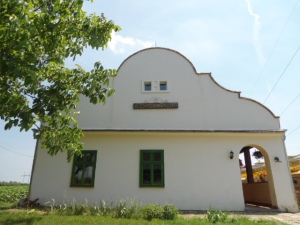
Crossing the Danube River means entering the flat Pannonia Plain where you orientate yourself only by the next tree or lonely house.  Considering that the official alphabet in Serbia is Cyrillic and that road signs are rare then that tree or house takes on more importance during your journey. Nature at this time of year (May 2012) generously painted everything in a lush green cloaking the trees and houses from sight. Everything looked the same especially for four city girls. Confused and tired by the oppressive heat we decided to stop along the way at Salas, called Sekin Salas which means Sisters Ranch. If you want to experience the real Serbia you should try to stay at one of the many ranches which offer a combination of rural Serbia with good food, clean air and lots of activities – horse riding, fishing, cooking classes…embroidery classes…During our hour stop we managed to meet the loveable Rasha, a ginger corgi who we considered stealing away, but after realising that Rasha has friends on the Ranch – three cats, two goats, a pheasant, an over-protective chicken with eight yellow chicks and two more dogs lazily asleep in the front garden - we decided that Rasha had a better life than we did, so we left him in his natural surroundings.
 
After refreshments and taking photos of everything that represented the old, disappearing Serbia that was so generously on display in the house, we continued driving towards Kovacica, a place well known for its Slovak naive art.

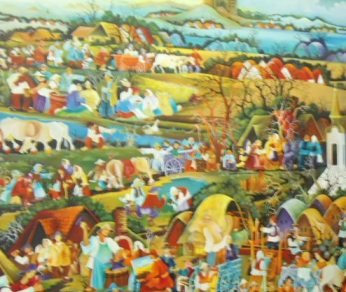
The Museum of Naive Folk Art is situated centrally on the main street. The Museum itself is very small but very rich in the numbers of paintings they own so the exhibition keeps changing all the time. The first one to strike you is a huge, colourful and lively painting by Jan Glozik illustrating the 200 years since the Slovak people moved from what was then the Austro-Hungarian Empire to the eastern border, nowadays Serbia, by order of the Emperor. The painting consists of 200 people representing each year since they moved to this part of the world. If you have a very good eye you can see a self-portrait of the painter incorporated into the maze of colours. 

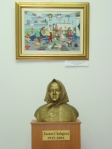
The left side of the museum has an exhibition of another famous naïve art painter, Martin Janos, whose paintings emphasise the hands and feet and thereby the hard manual work on the farms of the region. The third room is dedicated to the Queen of naïve art, Zuzana Halupova. There are 31 paintings exhibited here, most of them oil on canvas. She, as with Martin Janos, has a leitmotif which is that each painting has a girl in a pink skirt somewhere in it. Zuzana never had kids of her own and so she put one in every one of her paintings. She was member of the children’s charity UNICEF and in 1974 she painted the UNICEF Christmas Card which was sold worldwide.  She left more than 1000 paintings to the museum but due to the lack of the space only a certain number can be shown. There are talks about a new, bigger Museum to be opened in a different location.

Outside the Museum there is a courtyard with three galleries, in one of them you can have your own portrait painted. All the galleries are run by local painters who can tell you about local life and how they have preserved their culture and traditions for over 200 years.   Mr Pavel Babka , a successful painter who exhibits all around the world and is the owner of the largest gallery, pointed out that even when a painter becomes worldwide successful, he still stays in Kovacica, within very strong Slovak Community.

After a good three hours at this artists’ colony we bought a couple of pictures that were most memorable to us, and decided to sit outside the Museum on a bench colourfully painted in bright flowers. Two local ladies dressed in Slovakian costume passed us slowly on bicycles. The only sign reminding us that we were in Serbia and not Slovakia was a road sign with the street name in Cyrillic.

 To create your own perfect day tour of  Kovačica email Tara at Tara@ReadyClickAndGo.com for ideas and we can customise a tour to suit you with a private guide to show you around. See our website www.ReadyClickAndGo.com for sample sightseeing tours of Serbia.