Showing posts with label holidays in serbia. Show all posts

Smederevo Fortress, Serbia

Day tours in Serbia, Smederevo-Fortress-ReadyClickAndGo
In 1428 the Turkish Empire was at war with Hungary and sent a demand to Djordje Brankovic, ruler of Serbia, to sever all connections with Hungary, to send an army to join Turkey and to hand over his daughter Maria with a dowry of Serbian land. Djorjde Brankovic promised to meet all demands but in return asked if he could build a fortification on the Danube near Smederevo against the Hungarians. Strangely enough the Turks didn’t realise at that point that the same fortification could be used by the Hungarians to enter the Turkish Empire or that the Serbs could escape across the river in case of attack. Permission was granted. The fortification was finished in record time, in 2 years.
Things to see in Serbia, Djuradj Brankovic, ReadyClickAndGoBefore marrying his daughter Maria to the Sultan, Djordje married another one off to the heir to the Hungarian throne, securing an important ally and was then able to start negotiating with the Venetians about joining forces to attack the Turkish Ottoman Empire. But by this time the Sultan realised the potential danger of the union between Serbia, Hungary and Venice and decided in 1439 to capture the Smederevo fortress. They couldn’t capture it outright but they besieged it for three months until the fortress surrendered.  Djordje managed to escape the country by boat over Danube into Hungary, to his estate at Tokay where he planted vines from Smederevo which eventually produced the famous Tokay wine.
The Fortress of Smederevo had to be reinforced and work started in 1444 when Djordje returned to Smederevo and lasted until 1456.  The fortress was surrounded by water on three sides - from the Danube River on one side, the Jezeva River on another, and on a third by a canal across the promontory. All along the edge of the fortress high bastioned walls were erected every 200 feet. The northern part of the fortress is the Little Forte which was home to Djordje and his wife and where the wall of great hall still stands, the windows still look across the Danube towards Hungary. The Forte was the second line of defence behind the moat with four richly decorated bastions. One of them is engraved with a cross and the year 6938 which is the year of the beginning of the world according to Greek Orthodoxy.
What to see in Serbia, Smederevo Fortress, ReadyClickAndGoDjordje Brankovic was getting old and not keeping up with new developments whereas the Sultan was more progressive. In April 1453 the Sultan fired the first guns at the centre of Byzantium Empire, Constantinople and after five weeks of heavy bombardment “the pearl of east”  become Turkish. The Sultan, nicknamed the Conqueror, continued his expansion to the West and Serbia and in 1454 issued an ultimatum to Djordje Brankovic who ignored it until the fortress was strengthened. Unfortunately the fortress was never ready for cannons and the plague which killed the king. He left his wife who died under suspicious circumstances and his son who died in 1458 but not before he married one of his daughters to the Bosnian king, Stefan Tomasevic, who entered Smederevo at the end of the same year and become the last ruler of medieval Serbia. He changed his religion to Roman Catholicism which for the Orthodox Serb was worst betrayal of his kingdom. The Serbs started negotiating with the Sultan and scared King Stefan Tomasevic fled for his life from Smederevo with his family. The doors of Smederevo Fortress were open to Mahomet the Conquerer on 20th June 1459 and for the next three hundred and fifty years Serbia ceased to exist.
The fortress today has best preserved buildings of medieval Serbia, still standing proudly above the Danube despite damage during WWII from bombing by the Allies and an explosion in the ammunition store used by the Germans.  Smederevo fortress is easily accessible on a day tour from Belgrade. For more information about day tours to Smederevo or anywhere in Serbia please email Tara@ReadyClickAndGo.com
EASTER IN SERBIA – MONASTERIES AND FORTRESSES ON THE DANUBE


2013 marks the 1700th anniversary of the Edict of Milan that granted religious freedom for Christianity in the Roman Empire and was proclaimed by one of 17 Serbian-born Roman Emperors, Constantine the Great. In this jubilee year we therefore offer the opportunity to celebrate an Orthodox Easter in Serbia at the breathtaking Jazak Monastery in the stunning Fruska Gora of Vojvodina. Some of Central Europe’s greatest unsung treasures can be found in Serbia – immense fortresses on the Danube River that bravely challenged the invading Turks, and splendid Orthodox monasteries in remote forests that symbolised Serbia’s spiritual and cultural identity throughout the dark centuries of Ottoman occupation. This intriguing and carefully-crafted 7-day small-group tour explores Serbia’s rich and turbulent past whilst offering visitors the opportunity to savour her landscapes, villages and vineyards, staying in comfortable guesthouse accommodation with all meals included. The highlight may well be Midnight Mass at one of the region’s finest Orthodox monasteries on Easter Sunday.
Thursday 2 May 2013 Belgrade On arrival at Belgrade’s Nikola Tesla Airport you will be met and transferred to your guesthouse for an overnight stay.
Friday 3 May Silver Lake Depart from Belgrade and drive along the course of the Danube to Viminacium,a Roman city where you can see the largestamphitheatre in the Balkans, seating 12,000. Continue to Golubac, and tour the dramatic 14th century fortress constructed on a rocky outcrop over the Danube River at the border between Hungary and the Ottoman Empire, nowadays the border between Romania and Serbia. Cruise on the Danubeas it narrows between 1000ft-high limestone cliffs that form the stunning ‘Iron Gate’ Gorge before continuing by road to the enchanting Silver Lake nearby for an overnight stay in guesthouse accommodation.
Saturday 4 May Vrdnik Head to the city of Smederevo and visit the impressive medieval fortress – when it was conquered by the Turks the entire region capitulated and 350 years of Ottoman occupation began. Drive on to Vrsac, a small town in Vojvodina, famous for its fine churches and civic buildings as well as its vineyards. A short distance away is the village of Kovacica well-known for its ‘naive’ art – local farms, families, houses, harvests, weddings and wheatfields – that represent the traditional values and culture of which the local population is fiercely proud. After visiting the art gallery continue to Vrdnik in the heart of the Fruska Gora National Park, to stay 3 nights in a local bed and breakfast. Tonight attend midnight mass at the magnificent Jazak Monastery.
Sunday 5 May Vrdnik This morning walk to one of the most significant Serbian Orthodox churches of the region, Vrdnik-Ravanica, with its ornately carved and gilded iconostasis featuring the Serbian saints, one of 16 in Fruska Gora founded by monks who fled the Turkish invasion in the middle ages and found refuge in the densely wooded hills of the region. These monasteries became beacons of spiritual hope and nationalism during the long centuries of Ottoman occupation. The afternoon is free to relax in Vrdnik, perhaps to enjoy its famous thermal waters at the spa, or to trek up to the medieval tower.
Monday 6 May Vrdnik Today’s tour uncovers two more beautiful 16th century monasteries, Novo Hopovo and Velika Remeta, both with fine frescoes, and enjoy the delightful landscapes of the ‘holy mountain’.
Tuesday 7 May Belgrade Depart Vrdnik for Sremski Karlovci, a handsome town, to visit the seminary, the Residence of the Patriarch where there is a breathtaking array of icons in the chapel, and the rich interior of the Orthodox Cathedral with its magnificent iconostasis. Visit a local winery for awine tasting then continue to Novi Sad. This is Serbia’s second largest city and is overlooked by the impressive Petrovaradin fortress with panoramic views of the town and Danube River. Stroll through the charming old quarter, Stari Grad, and see some of its numerous churches and its grand architecture, reminiscent of many more famous central European cities, before returning to Belgrade for a final night. Extra nights in Belgrade with sightseeing are available.
Wednesday 8 May Depart Transfer from the city to the airport for your flight.
Easter in Serbia
Price per person in twin room £650 Single supplement on request
Price includes 6 nights in comfortable guesthouse accommodation with ensuite bathroom, all meals (continental breakfast, two course lunch and two course dinner) from dinner on Day 1 to breakfast on Day 7, transport and all excursions and relevant entrance fees as described, English-speaking local guide, all local taxes and tolls. Please note that your guesthouse may be self-catering accommodation, in which case a fresh breakfast will be delivered to you in the mornings, or the kitchen stocked for you to prepare your own.
Not included international flights, travel insurance, drinks with meals, hotel services such as laundry or telephone, expenses of a personal nature.
For enquiries and bookings please ring Tara on 01494 461234 or email Tara@ReadyClickAndGo.com

Kovačica, centre of Naive Art in Serbia


We crossed the only bridge in Belgrade over the Danube River – the old metal, heavy thing built in 1935.  Once on the other side of Belgrade we continued towards Pancevo city, well known for its accident-prone factories which sometimes pollute the whole of Belgrade. As it was Sunday, the day for the local antiques market, we couldn’t resist stopping for a quick browse for a “good deal”. We didn’t get anything except an old CD for 50p which worked until song number four. Regardless, we considered it a good deal.

Crossing the Danube River means entering the flat Pannonia Plain where you orientate yourself only by the next tree or lonely house.  Considering that the official alphabet in Serbia is Cyrillic and that road signs are rare then that tree or house takes on more importance during your journey. Nature at this time of year (May 2012) generously painted everything in a lush green cloaking the trees and houses from sight. Everything looked the same especially for four city girls. Confused and tired by the oppressive heat we decided to stop along the way at Salas, called Sekin Salas which means Sisters Ranch. If you want to experience the real Serbia you should try to stay at one of the many ranches which offer a combination of rural Serbia with good food, clean air and lots of activities – horse riding, fishing, cooking classes…embroidery classes…During our hour stop we managed to meet the loveable Rasha, a ginger corgi who we considered stealing away, but after realising that Rasha has friends on the Ranch – three cats, two goats, a pheasant, an over-protective chicken with eight yellow chicks and two more dogs lazily asleep in the front garden - we decided that Rasha had a better life than we did, so we left him in his natural surroundings.
 
After refreshments and taking photos of everything that represented the old, disappearing Serbia that was so generously on display in the house, we continued driving towards Kovacica, a place well known for its Slovak naive art.

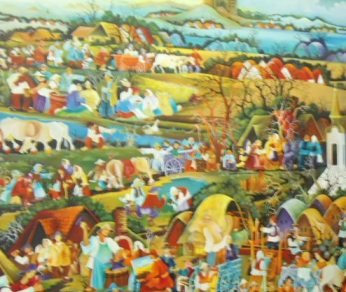
The Museum of Naive Folk Art is situated centrally on the main street. The Museum itself is very small but very rich in the numbers of paintings they own so the exhibition keeps changing all the time. The first one to strike you is a huge, colourful and lively painting by Jan Glozik illustrating the 200 years since the Slovak people moved from what was then the Austro-Hungarian Empire to the eastern border, nowadays Serbia, by order of the Emperor. The painting consists of 200 people representing each year since they moved to this part of the world. If you have a very good eye you can see a self-portrait of the painter incorporated into the maze of colours. 

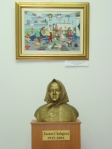
The left side of the museum has an exhibition of another famous naïve art painter, Martin Janos, whose paintings emphasise the hands and feet and thereby the hard manual work on the farms of the region. The third room is dedicated to the Queen of naïve art, Zuzana Halupova. There are 31 paintings exhibited here, most of them oil on canvas. She, as with Martin Janos, has a leitmotif which is that each painting has a girl in a pink skirt somewhere in it. Zuzana never had kids of her own and so she put one in every one of her paintings. She was member of the children’s charity UNICEF and in 1974 she painted the UNICEF Christmas Card which was sold worldwide.  She left more than 1000 paintings to the museum but due to the lack of the space only a certain number can be shown. There are talks about a new, bigger Museum to be opened in a different location.

Outside the Museum there is a courtyard with three galleries, in one of them you can have your own portrait painted. All the galleries are run by local painters who can tell you about local life and how they have preserved their culture and traditions for over 200 years.   Mr Pavel Babka , a successful painter who exhibits all around the world and is the owner of the largest gallery, pointed out that even when a painter becomes worldwide successful, he still stays in Kovacica, within very strong Slovak Community.

After a good three hours at this artists’ colony we bought a couple of pictures that were most memorable to us, and decided to sit outside the Museum on a bench colourfully painted in bright flowers. Two local ladies dressed in Slovakian costume passed us slowly on bicycles. The only sign reminding us that we were in Serbia and not Slovakia was a road sign with the street name in Cyrillic.

 To create your own perfect day tour of  Kovačica email Tara at Tara@ReadyClickAndGo.com for ideas and we can customise a tour to suit you with a private guide to show you around. See our website www.ReadyClickAndGo.com for sample sightseeing tours of Serbia.


Bus ride from Serbia to Bosnia via Croatia


His posture was like Fagin’s from Oliver Twist, only he was collecting bus tickets not money.
“If we get refused entry I’ll blame you!“ he said, not making eye contact.

I began to calculate the number of passengers on the bus times the cost of the ticket and blessed all my debit cards stacked in my wallet. I had enough money to pay for return tickets for all of us, luckily only 12!

“Have you ever crossed the border with a British Passport?“’

“Many times, but not  the Croatian border from the Serbian side! “

He shook his head in disbelief and walked off, cursing loud enough for me to hear.

I felt bad but secretly I knew there shouldn’t be any problem travelling by bus from Belgrade into Bosnia via Croatia as I checked the FCO advice and they clearly state there are no visa requirements for UK nationals when travelling to any of these countries. The problem is that when purchasing your bus ticket no one asks you which passport you are travelling on as they presume that you are a national either ofSerbiaCroatia or Bosnia in which case you don’t need a visa and sometimes you can cross borders with local ID. I could cross the border directly from Serbia to Bosnia but the bus journey is horrendously long – 12 hours!

day trips in Bosnia, day trips in Croatia, ReadyClickAndGo, day tours in Bosnia, Day tours in CroatiaAfter a drive of only an hour and a half through the so-called Panonnian Sea of cultivated fields we arrived on the western border ofSerbia. A guard with a serious face half covered by his hat came on board and colleted the IDs, passports and travelling documents which Mr Fagin had collected. We quickly moved into the no-man’s land between Serbiaand Croatia. On the Croatian side there was a big decorated Christmas tree – I’m sure one wouldn’t be erected on  the Serbian side for our Christmas on the 7th January. Serbia and Croatia don’t celebrate the same Christmas but they have so much else in common. On the Croatian side there are lots of flags and in the corner of the lorry parking space I can spot the EC panel, a little bit damaged though.

Nothing happens and the 12 passengers including me are getting nervous, agitated and bored. Suddenly Mr Fagin announces we all have to get off the bus and go through passport control in a nearby building. Once in the building one of the older ladies asks an official if she could use the loo only to be refused as its’ apparently only for employees. We queue quietly, waiting for something to happen. I am the last one, childishly thinking if they refuse me the rest of the group could run off saying I am not with them.

Three girls young enough to be my daughters nonchalantly check my passport talking about boys and smoking. Was smoking banned Day trips in Bosnia, day trips in Croatia with ReadyClickAndGoinCroatia? I am sure it is in Serbia. The girls are clearly enjoyimg  their deep puffs which convinced me that smoking is de facto banned in Croatia but we are in the middle of nowhere, two days before Christmas, when most bosses are on holiday. Smoking is allowed today.

I came out of the building to meet Mr Fagin with a big smile, relieved that I was allowed to enter Croatia on my UK passport.

The drive between the Croatian and Bosnian border was monotonous and slow with a rattling coming from the old engine. The bus’s condition was very alarming , the seats were old, dirty, worn out and I was surprised it was allowed to cross international borders in its present conditions. I tuned my MP3 player into different radio stations which sometimes were Croatian, sometimes Bosnian, Hungarian, German and Serbian – all these different nationalities once lived in one country – Yugoslavia. It seemed Lady Gaga hadn’t arrived here  yet as all the radio stations broadcast music from the 80s. After three hours’ drive we arrived at the border of Bosnia but first we had to exitCroatia. The narrow road, not even a motorway, was Day trips in Bosnia, day trips in Croatia, day tours in Bosnia, day tours in Croatia, ReadyClickAndGopacked with lorries from different countries: Macedonia, Montenegro, Bosnia, Croatia, Slovenia…Again a uniformed guard come on board to collect passports and again they were returned by Mr Fagin. To enter Bosnia you have to cross the River Sava and to cross the River Sava you have to go over the bridge which was built during Tito’s time -­ it was narrow and slowed down the crossing even further. Once on the Bosnian side, the passports were collected by Mr Fagin, presented to a bored official and returned to us swiftly.

After five hours and four border crossings Mr Fagin was more than happy, he even managed a wink. We had arrived in Bosnia.