Showing posts with label day trips in serbia. Show all posts

The smallest church in the world?

by Olivera Milic. Conservationist and restorer, guardian of cultural heritage in her city and her country.
The smallest church in the World, ReadyClickAndGo
In the mid-17th century, a tiny church was built in Doinovici village, near Novi Pazar in Serbia. The church, better known as Marinica, is 2.5m x 1.5m (barely 4sq/m) and is thought to be the smallest church in the world.
Legend says:
“The pasha of Novi Pazar had long prohibited the natives to have their own temple. The natives were, however, persistent in their demands and in the mid 17th century a compromise was reached. Pasha finally allowed them to build a church, but gave them three tough conditions: the church had to be located on one of the hard to access spots, it had to be small and it had to be built in one night between dusk and dawn.”
The smallest church in the world, ReadyClickAndGo
This is how the Pasha wanted to prevent believers meeting in church in large numbers, so as not to plot against Turkish authority. However, they fulfilled all three conditions and Marinica was built in just one night, under the careful surveillance of the Pasha’s dignitaries. And today it’s a rare historic gem of a place with a great story and beautiful frescos!
It’s certainly the smallest church in Serbia – but is it the smallest church in the world? Let us know.

THE BODY OF QUEEN MARIA OF YUGOSLAVIA IS TO BE REPATRIATED TO SERBIA


The resting place of Queen Maria of Yugoslavia will be  at the St George’s Church in Oplenac, Serbia. The five-domed church was built in the style known as Serbian–Byzantium, a sort of oriental gothic style, between 1910 and 1930, by King Peter I who was a grandson of the founder of the royal family who led the Serbs in an uprising against the Ottoman Empire that had controlled the Balkans for centuries. The revolution was successful, the Ottomans were booted out and in 1811 Karadjordje was confirmed as the lawful ruler of Serbia and his heirs after him. At St George’s Church four of Serbia’s kings and 18 members of the Karadjordje dynasty are buried in the crypt, their tombs made of onyx from Decani in Kosovo, and representing the pearl of Serbia’s cultural and historical heritage. The most important characteristic of church is the mosaic that covers much of the interior walls, made from Murano glass from Venice. I loved the huge candelabra which is made of melted weapons from the Battle of Kajmackalan in WWI and in the shape of the medieval crown of Serbia but upside down, symbolising Serbia’s mourning at the loss of their country at the Battle of Kosovo in 1389. Entry tickets are 300 Serbian Dinars which is around GBP2.5 or Euro 3. The price includes entrance to St George’s Church (the curator is happy to give you lots of information in English), King Peter’s house (a small summer villa built in 1912 for his own use and today a museum), the villa of King Alexander I and Queen Mary (closed to visitors at the moment) and entry to the tower and Church of Our Blessed Lady of Karadjordje Town, dating from 1811-1813.
Day tours in Serbia, ReadyClickAndGo
Things to see and do in Serbia, ReadyClickAndGo
What to see and do in Serbia, ReadyClickAndGo
Things to see and do in Serbia, ReadyClickAndGo
Day tours in Serbia, ReadyClickAndGo
For more information about travelling to Serbia, day tours or things to see and do in Serbia  please email Tara@ReadyClickAndGo.com or check our website at www.ReadyClickAndGo.com 

Kovačica, centre of Naive Art in Serbia


We crossed the only bridge in Belgrade over the Danube River – the old metal, heavy thing built in 1935.  Once on the other side of Belgrade we continued towards Pancevo city, well known for its accident-prone factories which sometimes pollute the whole of Belgrade. As it was Sunday, the day for the local antiques market, we couldn’t resist stopping for a quick browse for a “good deal”. We didn’t get anything except an old CD for 50p which worked until song number four. Regardless, we considered it a good deal.

Crossing the Danube River means entering the flat Pannonia Plain where you orientate yourself only by the next tree or lonely house.  Considering that the official alphabet in Serbia is Cyrillic and that road signs are rare then that tree or house takes on more importance during your journey. Nature at this time of year (May 2012) generously painted everything in a lush green cloaking the trees and houses from sight. Everything looked the same especially for four city girls. Confused and tired by the oppressive heat we decided to stop along the way at Salas, called Sekin Salas which means Sisters Ranch. If you want to experience the real Serbia you should try to stay at one of the many ranches which offer a combination of rural Serbia with good food, clean air and lots of activities – horse riding, fishing, cooking classes…embroidery classes…During our hour stop we managed to meet the loveable Rasha, a ginger corgi who we considered stealing away, but after realising that Rasha has friends on the Ranch – three cats, two goats, a pheasant, an over-protective chicken with eight yellow chicks and two more dogs lazily asleep in the front garden - we decided that Rasha had a better life than we did, so we left him in his natural surroundings.
 
After refreshments and taking photos of everything that represented the old, disappearing Serbia that was so generously on display in the house, we continued driving towards Kovacica, a place well known for its Slovak naive art.

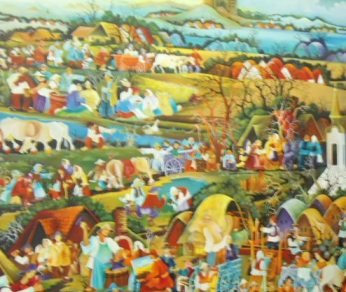
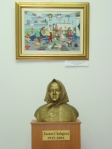
The Museum of Naive Folk Art is situated centrally on the main street. The Museum itself is very small but very rich in the numbers of paintings they own so the exhibition keeps changing all the time. The first one to strike you is a huge, colourful and lively painting by Jan Glozik illustrating the 200 years since the Slovak people moved from what was then the Austro-Hungarian Empire to the eastern border, nowadays Serbia, by order of the Emperor. The painting consists of 200 people representing each year since they moved to this part of the world. If you have a very good eye you can see a self-portrait of the painter incorporated into the maze of colours. 

The left side of the museum has an exhibition of another famous naïve art painter, Martin Janos, whose paintings emphasise the hands and feet and thereby the hard manual work on the farms of the region. The third room is dedicated to the Queen of naïve art, Zuzana Halupova. There are 31 paintings exhibited here, most of them oil on canvas. She, as with Martin Janos, has a leitmotif which is that each painting has a girl in a pink skirt somewhere in it. Zuzana never had kids of her own and so she put one in every one of her paintings. She was member of the children’s charity UNICEF and in 1974 she painted the UNICEF Christmas Card which was sold worldwide.  She left more than 1000 paintings to the museum but due to the lack of the space only a certain number can be shown. There are talks about a new, bigger Museum to be opened in a different location.

Outside the Museum there is a courtyard with three galleries, in one of them you can have your own portrait painted. All the galleries are run by local painters who can tell you about local life and how they have preserved their culture and traditions for over 200 years.   Mr Pavel Babka , a successful painter who exhibits all around the world and is the owner of the largest gallery, pointed out that even when a painter becomes worldwide successful, he still stays in Kovacica, within very strong Slovak Community.

After a good three hours at this artists’ colony we bought a couple of pictures that were most memorable to us, and decided to sit outside the Museum on a bench colourfully painted in bright flowers. Two local ladies dressed in Slovakian costume passed us slowly on bicycles. The only sign reminding us that we were in Serbia and not Slovakia was a road sign with the street name in Cyrillic.

 To create your own perfect day tour of  Kovačica email Tara at Tara@ReadyClickAndGo.com for ideas and we can customise a tour to suit you with a private guide to show you around. See our website www.ReadyClickAndGo.com for sample sightseeing tours of Serbia.


Visit to the Spa in Serbia - Visit to the Vrnjacka Banja

readyclickandgo in serbia, day tours in serbia, day trips in serbia, spas in serbia


I had decided to spend ten days in Vrnjacka Banja which is a spa situated in central Serbia, 200 km south of Belgrade close to Mount Goc and in the valleys of the Vrnjacka and  Lipovacka rivers. 
The return bus fare to Vrnjacka Spa is 850 dinar which is about £8 including the seat reservation. With your tickets and seat reservations you will get a small coin which gives you access to the departure platform for the bus. The buses are comfortable, clean and with air conditioning which is very important during the hot months of summer. At the moment, the Serbian Government is investing a huge amount of money in the motorways. Driving though the countryside is very pleasant, picturesque and during May when everything is in full bloom, very lush. The journey lasts around 3 ½ hours with short stops in the cities of Kraljevo and Krusevac to pick up other passengers. There are no toilets on the bus and the only snag is that you have to rush out of the bus station in either city, buy one of the special coins from the ticket office where queues could be a mile long, then run to the toilet! If you haven’t told your driver about your toilet excursion there is a good possibility he will leave without you!

We booked one of the best hotels in Vrnjacka Banja called The Breza, which was one of the hotels built for senior army officers. As times changed the hotel lost its glory but it’s still functional.  Officially the hotel has 3 stars but I think it should be rated lower, or refurbished. The carpets are not very clean, the hallways are dark, almost dirty, and the electric wires in some rooms look very scary – connected by isolation tape. My bed was a mattress which was ripped in the middle (I only found that out on our last day). We stayed in one of the apartments which overlooked the promenade and the park. Outside our windows there was a small balcony covered in the grass and fems. We had a TV in the room which during the day had only two channels and both of those in Serbian but during the evening you could get CNN. Our phone line was working and the fridge made a really strange noise so we decided not to use it at all. The bathroom was huge but really 1970s style. After a week the receptionist moved us to a different room which was much better – spacious, with a better mattress, a sofa, and extra bed. The TV worked during the day but we didn’t have a fridge. I preferred this room. The hotel has an indoor swimming pool, internet room with fast connection, library, restaurant and a room for table tennis, and, most importantly, a hairdresser – a cheap and good hairdresser. A cut and blow dry is only £4!!! The hotel accepts major credit cards but they prefer cash.  Breakfast is very basic – eggs, cheap salami, bread, cheese, butter, marmalade, jam, tea and coffee. As we were on half board we decided to have dinner as well which was freshly made, with different dishes every day and two choices. Also the staff was so friendly they would give you anything you asked for and if you are spoiled like me then you are in heaven. During our stay the hotel hosted two big conferences with people from all around Europe. The hotel was very accommodating and staff marvellous: hard working and always ready to put guests first. For that reason I am planning to go back and stay with in the Hotel Breza again regardless as to whether there are newer, more westernised, or better equipped hotels in the area.

I decided to take my mum on this trip to Vrnjacka Banja as she had a operation there years ago and the doctor recommended that she visits a spa regularly.

The Romans first came here for their health between the 2nd and 4th centuries, calling it AQUAE ORCINAE. The natural mineral waters here are an intrinsic part of the treatments – either by drinking them, inhaling steam, bathing, colonic irrigation and so on. You see a doctor when you arrive, and he prescribes the best utilization of the spa waters for you.    
      
readyclickandgo in serbia, day tours in serbia, day trips in serbia, spas in serbia
The central part of Vrnjacka spa is a well kept park, and we found there a memorial to the British doctors and nurses who helped Serbian soldiers during WWI. 
readyclickandgo in serbia, day tours in serbia, day trips in serbia, spas in serbia
Just outside the park is a castle called Belimirovic which is today a museum with three permanent exhibitions: photographs from 1914- 1918, a room with furniture before WWI and an exhibition of Easter eggs. Also concerts, ad hoc exhibitions, and plays take place here during the summer in an event called “100 days – 100 cultural happenings. On the opposite side of the castle on a small hill, there is the oldest building in Vrnjacka Banja- the Church of the Nativity of the Holy Mother of God built in 1834 by Prince Milos Obrenovic, and well preserved.

readyclickandgo in serbia, day tours in serbia, day trips in serbia, spas in serbia
The tourist office at Vrnjacka Banja is on the main street and easy to find. The girls are very well informed and happy to help with any enquires. As it was out of season I asked to hire a bike and she recommended a person near the Hotel Kralj whose main business is to repair old bicycles. He was happy to rent me one, in good condition, pink, girly as he said for 90 dinar which is £1 an hour on condition that I gave him some form of ID. I gave him my driving licence. He looked in his 70s but very fit for a man of his age. He also recommended a route to take. Of course I didn’t get a helmet - they are not obligatory in Serbia. Cycling up to the Hotel Borjak which is just outside Vranjcka Banja and in the hills wasn’t easy. Firstly I didn’t have a map and secondly I asked a small kid for directions who just said yes and brought me almost to the Goc Mountain which is opposite of where I wanted to be. An elderly lady sitting outside her house advised me in a motherly way that bikes are not for girls and that I was too far away anyway, which made me to turn back and cycle downslide which was a fantastic feeling. Nature is pristine here, and you can easily sit in the middle of the forest watching birds or admiring stones packed with different minerals. On the way down I stopped at a restaurant on the river and with a huge garden. It was very refreshing and I had 2 course meal for less then £8 including drinks and tips. 

The next day I arranged to visit the Zica Monastery which is around 25 km outside Banja.
readyclickandgo in serbia, day tours in serbia, day trips in serbia, spas in serbia
The Zica Monastery is an endowment of King Stefan the First Crowned and built between 1208 and 1220. Zica was the first seat of the autonomous Serbian Archbishops and it was there that 7 medieval Serbian rulers were crowned. It is painted in red – the royal colour of Serbia. The most significant part of the church is formed by the latest frescoes painted between 1309 and 1316. Nearly nothing has been saved from the once rich monastery treasury except the holy relic – the right arm of St. John the Forerunner laid in silver, which was brought to the monastery by St. Sava. Today it is preserved in St. Mary's Cathedral in Sienna. The Monastery was heavily bombed during WWII by the Germans and set on fire during their occupation.  Today it is a women’s monastery and there is only one fifth of the frescos left. The nuns support themselves by working on the land, making teas and honey which they sell. Worship takes place every day at 5 pm and I would recommend it to anyone. The singing is beautiful and the acoustics in the church are very good. The whole atmosphere is made more mysterious by closing the entry doors and the ancient rituals at the end of prayers.
readyclickandgo in serbia, day tours in serbia, day trips in serbia, spas in serbia
There are other Monasteries in close proximity to Vrnjacka Banja such us Ljubostnja , Studenica and newish one - Sv Petka. Also it is possible to organise a wine tour and horse riding.
Evening life in Vrnjacka Banja includes lots of walking up and down or sitting in the gardens of so many cafés and restaurants. Alternatively you can listen to live music, a concert or go to the cinema. Or even better just go to bed!                                       
For more information regarding travelling in Serbia please email Tara@ReadyClickAndGo.com

Pavle Beljanski Memorial Collection of Art in Novi Sad


Next door to the Gallery of Matica Serbia there is the fascinating Pavle Beljanski Memorial Collection of Art.


Who is Pavle Beljanski?


Pavle Beljanski was born in a sleepy town on the Danube River, Veliko Gradiste, in Serbia, in 1892, into a respectable middle-class family. After school he went to study law at Belgrade University, but WWI came along and he abandoned his studies to enrol into the Pupils' Battalion in Skopje, winning several medals before he contracted TB and was invalided out of the army. Pavle then went to Paris to study law at the Sorbonne, and after the war to Stockholm to work as a clerk in the embassy of the new Kingdom of Serbs, Croats and Slovenes there.

This was the beginning of a very interesting diplomatic career and the beginning of his renowned art collection. He started buying in Berlin and Vienna when he was posted there, striking up friendships with young artists such as Marino Tartalja who were studying in Europe's major cultural capitals, and when he returned to Belgrade in 1925 he kept up these friendships with young artists from his own country. He decided to collect the works of contemporary artists whose quality was recognised internationally, and create an anthology of his nation.

Between the two world wars Beljanski worked hard on expanding his collection and appointed the painter Jefto Peric to choose and buy pieces. He also promoted their work through exhibitions and writing reviews for numerous art magazines.

WWII disrupted his plans and his main worry was to keep his collection safe and out of reach of the Nazis. When the Germans formed a commission for the seizure of works of art in Belgrade, Beljanski was tipped off by a good friend who was a member of the commission. Beljasnki hid all his art in a box, and buried it in the coal cellar, keeping out any expensive frames which he displayed with mediocre paintings in them. When the commission come to value his collection they decided it wasn’t of any importance and left.
He later said: “ Each of these painting is part of my life! Each of them went through my heart... "

This devotion to his collection saved his life during WWII. His family moved to Svilajnac in order to avoid the full atrocities of the German invasion of Belgrade  but Beljanski decided to stay in the city and look after his paintings. Unfortunately Sviljanc was bombed on 24th September 1944 and the Beljanski family house was hit. Pavle Beljanski lost two sisters, a brother and their families. Beljanski was left on his own.

At the end of WWII the new country of Yugoslavia needed experienced diplomats and Pavle Beljanski was invited into the diplomatic corps again. As a skilful and knowledgeable diplomat he established relations with many countries and as a result was rewarded by different countries such as Poland, Ethiopia, Greece and Egypt. Beljasnki's second spell in the diplomatic service lasted officially until 1958.

In October 1945 an exhibition of 67 paintings was arranged at the City Museum in Sombor. This exhibition was the first one in post-war Yugoslavia but also it was the first time Beljanski could see his collection in a gallery. The following year he arranged for several foreign diplomatic missions in Yugoslavia to visit the exhibition which despite being his private property, was thereby approved as ideologically sound by his communist masters. The same year ten paintings were chosen for a major retrospective exhibition of painting and sculpture of the people of Yugoslavia 19th and 20th centuries, which toured several Eastern European capitals.

Between 1952 and 1957 120 works from the Pavel Beljanski Collection were chosen for exhibition at the National Museum in Belgrade. Due to the size of the collection not all pieces could be shown at once, the exhibits were rotated to bring as many works to the public as practically possible. Pavle considers donating his art to a museum but under certain conditions, the main one being that part of it always had to be displayed, and displayed apart from other paintings in the museum. Only the museum in Vojvodina accepted his conditions and in 1957 he signed a contract with the Executive Council who built a gallery just for the Beljanski Collection.  

The Pavle Beljanski Memorial Art Gallery contains paintings, sculptures, drawings and tapestries over two floors. One of the smaller parts of the Memorial is dedicated to Pavel Beljasnki's life and you can see his diplomatic uniform, photographs of his parents, his medals and his first art collections. From a total of 185 works you can find 144 exhibited. 

Entry is just £1. The Pavle Beljanski Memorial is open  from Wednesday to Sunday from 1000-1800, Thursday 1300-2100 and closed on Monday and Tuesday. The list of paintings at the Pavle Beljanksi Memorial Collection you can find here. My favorite painting is Velika Iza by Vlaho Puhovac shown on the right. 

If you are looking for a day trip to Novi Sad and the Pavle Beljanski Memorial with a private guide, driver and car please email Tara@ReadyClickAndGo.com


Bus ride from Serbia to Bosnia via Croatia


His posture was like Fagin’s from Oliver Twist, only he was collecting bus tickets not money.
“If we get refused entry I’ll blame you!“ he said, not making eye contact.

I began to calculate the number of passengers on the bus times the cost of the ticket and blessed all my debit cards stacked in my wallet. I had enough money to pay for return tickets for all of us, luckily only 12!

“Have you ever crossed the border with a British Passport?“’

“Many times, but not  the Croatian border from the Serbian side! “

He shook his head in disbelief and walked off, cursing loud enough for me to hear.

I felt bad but secretly I knew there shouldn’t be any problem travelling by bus from Belgrade into Bosnia via Croatia as I checked the FCO advice and they clearly state there are no visa requirements for UK nationals when travelling to any of these countries. The problem is that when purchasing your bus ticket no one asks you which passport you are travelling on as they presume that you are a national either ofSerbiaCroatia or Bosnia in which case you don’t need a visa and sometimes you can cross borders with local ID. I could cross the border directly from Serbia to Bosnia but the bus journey is horrendously long – 12 hours!

day trips in Bosnia, day trips in Croatia, ReadyClickAndGo, day tours in Bosnia, Day tours in CroatiaAfter a drive of only an hour and a half through the so-called Panonnian Sea of cultivated fields we arrived on the western border ofSerbia. A guard with a serious face half covered by his hat came on board and colleted the IDs, passports and travelling documents which Mr Fagin had collected. We quickly moved into the no-man’s land between Serbiaand Croatia. On the Croatian side there was a big decorated Christmas tree – I’m sure one wouldn’t be erected on  the Serbian side for our Christmas on the 7th January. Serbia and Croatia don’t celebrate the same Christmas but they have so much else in common. On the Croatian side there are lots of flags and in the corner of the lorry parking space I can spot the EC panel, a little bit damaged though.

Nothing happens and the 12 passengers including me are getting nervous, agitated and bored. Suddenly Mr Fagin announces we all have to get off the bus and go through passport control in a nearby building. Once in the building one of the older ladies asks an official if she could use the loo only to be refused as its’ apparently only for employees. We queue quietly, waiting for something to happen. I am the last one, childishly thinking if they refuse me the rest of the group could run off saying I am not with them.

Three girls young enough to be my daughters nonchalantly check my passport talking about boys and smoking. Was smoking banned Day trips in Bosnia, day trips in Croatia with ReadyClickAndGoinCroatia? I am sure it is in Serbia. The girls are clearly enjoyimg  their deep puffs which convinced me that smoking is de facto banned in Croatia but we are in the middle of nowhere, two days before Christmas, when most bosses are on holiday. Smoking is allowed today.

I came out of the building to meet Mr Fagin with a big smile, relieved that I was allowed to enter Croatia on my UK passport.

The drive between the Croatian and Bosnian border was monotonous and slow with a rattling coming from the old engine. The bus’s condition was very alarming , the seats were old, dirty, worn out and I was surprised it was allowed to cross international borders in its present conditions. I tuned my MP3 player into different radio stations which sometimes were Croatian, sometimes Bosnian, Hungarian, German and Serbian – all these different nationalities once lived in one country – Yugoslavia. It seemed Lady Gaga hadn’t arrived here  yet as all the radio stations broadcast music from the 80s. After three hours’ drive we arrived at the border of Bosnia but first we had to exitCroatia. The narrow road, not even a motorway, was Day trips in Bosnia, day trips in Croatia, day tours in Bosnia, day tours in Croatia, ReadyClickAndGopacked with lorries from different countries: Macedonia, Montenegro, Bosnia, Croatia, Slovenia…Again a uniformed guard come on board to collect passports and again they were returned by Mr Fagin. To enter Bosnia you have to cross the River Sava and to cross the River Sava you have to go over the bridge which was built during Tito’s time -­ it was narrow and slowed down the crossing even further. Once on the Bosnian side, the passports were collected by Mr Fagin, presented to a bored official and returned to us swiftly.

After five hours and four border crossings Mr Fagin was more than happy, he even managed a wink. We had arrived in Bosnia.

Merry Christmas from Belgrade, Serbia!


I am sitting on the 3rd floor of my mum's apartment in the city center of Belgrade and emailing all around the world wishing a Merry Christmas to all my friends scattered around the globe, from Rachel in Nepal who is doing charity work after being dumped yet again, to Elke in Thailand after being made redundant yet again, to Fran in London doing an MSc in Environmental Science after deciding that she had enough of travelling. Out of sheer fun, I wish Merry Christmas to my friends in China even I know they don’t celebrate it. They do the same to me.


I can hear my mum on the phone to her brother in Holland and her best friend just across the river Danube which is just at the end of the number 706 bus in a different part of Belgrade and wish them a Merry Christmas too.
Despite the celebratory feelings we, the Serbian people, don't actually celebrate Christmas on the 25th December. Our Christmas comes a bit later on the 7th January - some people in the West call us the "Eastern Catholics". This is because of our use of the traditional Julian Calendar, under which December 25 falls on the Gregorian calendar's January 7. The Julian calendar, a reform of the Roman calendar, was introduced by Julius Caesar in 46 BC and it has a regular year of 365 days divided into 12 months, and a leap day is added to February every four years. Hence the Julian year is on average 365.25 days long.
Basically, the only difference is that the Gregorian calendar is 13 days behind the Julian calendar. 

During this festive time, you greet another person with "Christ is Born," which should be responded to with "Truly He is Born." The Serbian name for Christmas is Božić , which is the diminutive form of the word bog, meaning 'God'.

Most Serbian families celebrate the Christmas/New Year season with a Christmas tree in the house. The decoration of the tree is a very good opportunity to gather family members around, and the main tradition is for the head of the household to go into a forest on Christmas Eve (6th January) preferably before sunrise, or at least before noon, to select a young and straight oak tree and a log cut from it is in the evening ceremoniously put on the domestic fire. A bundle of straw is taken into the house and spread over the floor.

On Christmas Day, (7th January) the celebration is announced at dawn by church bells and by shooting. Huge importance is given to the first visit a family receives that day. People expect that it will bring prosperity and well-being for their household in the ensuing year; this visit is often pre-arranged. Christmas dinner is the most celebratory meal a family has during a year. A special, festive loaf of bread is baked for this occasion, and the main course is roast pork . It is not traditional in Serbia to exchange gifts at Christmas. Gift giving is, nevertheless, connected with the holiday, being traditionally done on the three Sundays that immediately precede it. Children, women, and men, respectively, are the set gift-givers on these three days. Closely related to Christmas is New Year's Day by the Julian calendar (January 14 on the Gregorian calendar), whose traditional folk name is Little Christmas.

I wont be in Belgrade for little Christmas but I am sure I will celebrate it in London with my friends Rachel, Elke, Fran….