Showing posts with label day tours in serbia. Show all posts

Zica Monastery

Visit to the Zica Monastery, Serbia, ReadyClickAndGo
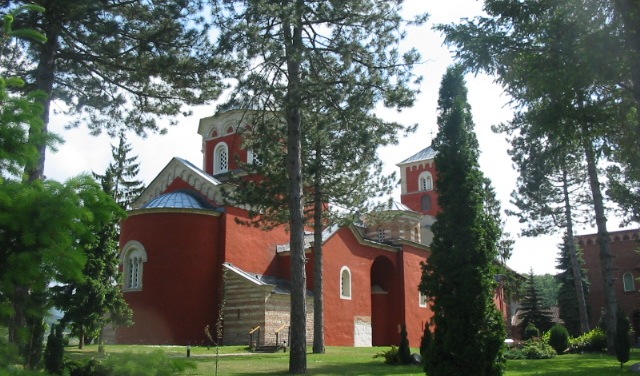
Zica Monastery is situated around 25 km outside of Vrnjacka Banja which is in central Serbia, 200 km south from Belgrade and the Monastery is an endowment of King Stefan the First Crowned and built between 1190 and 1124.  Zica was the first seat of the autonomous Serbian Archbishops and it was there that 7 Serbian kings were crowned, the latest one King of Yugoslavia. It is painted in red – Serbian Royal colour. The most significant composition is formed by the latest frescoes painted between 1309 and 1316. Nearly nothing has been saved from the once rich monastery treasury except the holy relict – right arm of St. John the Forerunner laid in silver, which was brought to the monastery by St. Sava. Today the holy relic is preserved in St. Mary’s Cathedral in Sienna. The Monastery was heavily bombed during WWII by Germans and set on fire during their occupation. Today is a women’s monastery and there is only one fifth of frescos left from original work. The nuns support themselves by working on land, making teas and honey which they are selling. Worship takes place very day at 5 pm and I would recommend it to anyone. Singing is beautiful and acoustic in the church is very good. The whole atmosphere is mystified by closing entry doors and old ritual by nuns at the end of pray.
How to get to the Monastery Zica:
By bus from Belgrade to Vrnjacka Banja then by local bus. You will have to stay overnight in Vrnjacka Banja. Or pre book a full day private tour with car, driver and local guide to the Monastery Zica from Belgrade with ReadyClickAndGo.  For more information please email tara@ReadyClickAndGo.com

The smallest church in the world?

by Olivera Milic. Conservationist and restorer, guardian of cultural heritage in her city and her country.
The smallest church in the World, ReadyClickAndGo
In the mid-17th century, a tiny church was built in Doinovici village, near Novi Pazar in Serbia. The church, better known as Marinica, is 2.5m x 1.5m (barely 4sq/m) and is thought to be the smallest church in the world.
Legend says:
“The pasha of Novi Pazar had long prohibited the natives to have their own temple. The natives were, however, persistent in their demands and in the mid 17th century a compromise was reached. Pasha finally allowed them to build a church, but gave them three tough conditions: the church had to be located on one of the hard to access spots, it had to be small and it had to be built in one night between dusk and dawn.”
The smallest church in the world, ReadyClickAndGo
This is how the Pasha wanted to prevent believers meeting in church in large numbers, so as not to plot against Turkish authority. However, they fulfilled all three conditions and Marinica was built in just one night, under the careful surveillance of the Pasha’s dignitaries. And today it’s a rare historic gem of a place with a great story and beautiful frescos!
It’s certainly the smallest church in Serbia – but is it the smallest church in the world? Let us know.

Visit the Princess Ljubica Residence in Belgrade

Visit the Princess Ljubica Residence in Belgrade, ReadyClickAndGo

Soak up the atmosphere of a unique historic house in the heart of Belgrade, one that perfectly reflects the duality of traditional Ottoman and 19th century European influences that battled for supremacy in Serbia at that time.
The Princess’s Residence was built in 1831 for Princess Ljubica who was the wife of the first Prince of Serbia, Milos Obrenovic, who secured Serbia’s independence from the Ottomans. The house is located in the heart of Belgrade squeezed between St. Michael’s Cathedral, the Patrichast and the oldest kafana in Belgrade. The front garden is large and the position is such that the house would have had a beautiful view of the confluence of the Danube and Sava from its back garden. The architecture is a mishmash of traditional Ottoman style and then modern European neo-baroque, Napoleon III and Altdeutch styles.
Princess Ljubica Residence, Belgrade, ReadyClickAndGoMy feeling is that the rooms of the Residence were used according to the guests – if someone very European-orientated entered the house then they would be taken to some of the many European style rooms, decorated with oval wooden tables and comfortable hand made chairs where afternoon tea would be served, while anyone with a Turkish background would be taken to the main lounge set in the typical Ottoman style with wooden benches covered in thick, soft velvet and served Turkish coffee with rahtluk (Turkish delight). A clever arrangement as Serbia wasn’t yet totally free of Turkish claws but was desperate to be seen as European.
There are ground and first floor set in the same layout with the size of the rooms the same on both floors. The present-day ticket office used to be a waiting room for visitors. From there you are led into a spacious lounge which is in a typical Ottoman style. The room on the left is set in the European style and has a small en-suite bathroom which was very modern at that time in Serbia.
This room is connected to one of the best preserved hammans in Belgrade which leads me to believe this part of the house was the Rooms at the Princess Ljubica Residence, Belgrade, ReadyClickAndGoprincess’s private quarters, but today the room looks like a modern European meeting room. On the wall you can see portraits of the Obrenovic family and the most interesting one is of Milos Obrenovic, the first Prince of Serbia, with a medal depicting the head of the Sultan, signifying that Serbia was still part of the Ottoman Empire.
Opposite the lounge in the right-hand corner is a room set in the Turkish style covered in hand-made carpets and wooden benches set below big windows opposite the entrance. There are wardrobes which were used to store bedding and linen. Strangely enough there are no bedrooms because they apparently slept on the floor.
On the right side of the main lounge or divan there is another room in the typical Turkish style, minimalist, with lots of benches along the main wall, and woodwork decorated with shells, and a Turkish smoking pipe. The walls are bare, there are no portraits or mirrors. The middle of the room is empty except for the big thick carpet. It seems like another meeting room but a bit more exotic.
Rooms at the Princess Ljubica Residence, Belgrade, ReadyClickAndGoIn the left corner of the house there are two rooms which appear to be the private family quarters where less formal meetings would take place. To get to the first floor you have to walk up the best preserved wooden staircase in Belgrade, with wide, carved treads.
The first floor is the same as the ground floor – a mix of different styles and with rooms in the the same position as on the ground floor. There is a big basement too which is used by the National Museum to host some of their many exhibitions. They are free to visit.
Princess Ljubica’s Residence is a historic monument of the Obrenovic Royal Family, conveniently located and a great place to spend an hour or two to get the feel of the era between the Austro-Hungarian and Ottoman Empires. It’s a shame there is little information on the person the house is dedicated to – Princess Ljubica herself.
For more information about day tours in Belgrade and Serbia please email Tara@ReadyClickAndGo.com or visit our site at www.ReadyClickAndGo.com

The Chapel of Peace, Sremski Karlovci

Day Tours in Serbia, Visit Chapel of Peace in Sremski Karlovci, Serbia, ReadyCLickAndGo
Around 50 miles north of the capital city of Serbia, Belgrade, on the slopes of the Fruska Gora National Park and on the right bank of the Danube River, is one of Serbia’s most important spiritual and cultural towns, Sremski Karlovci, a small town easily accessible on a day tour from Belgrade.
Since 1713, this place has been the seat of the Serbian Archbishops so don’t be surprised if among the sea of tourists from different countries you come across a group of black-robed Orthodox priests come to visit the ornate 19th century Archbishop’s Residence. Especially famous for its good wines and honey (which both you can taste at various establishments around the town), its local dessert kuglof (a fruity, spiced cake), its beautiful baroque architecture and very nice inhabitants, Sremski Karlovci is also well known for its contribution to history books since it was here that the term ‘round table’ was first used when describing the signing of a peace agreement. The first peace agreement to be so described was signed here in 1699 between the Turkish, Polish, Venetians and Austrians, and it was thrashed out around a round table on a site a little way out of the town which is commemorated by a circular building, the Chapel of Peace, that has four doors, one for each party to the treaty.
According to the caretaker of the Chapel of Peace, a well-informed and talkative chap, this unusual building is beginning to be popular with visitors again since the EC decided to invest in its reconstruction on the condition that it opened its fourth door behind the altar, the so-called Turkish Door. When we came to visit the Chapel of Peace there was no one to greet us except strong winds and closed doors. We, like history-hungry peeping toms, looked through the windows and keyholes trying to catch a glimpse of the past. Suddenly a tall guy appeared in front of us telling us to go to the opposite side of building and he would open the door for us. It seemed strange that he did not tell us to enter the building with him, but later he explained that he only carries the key for the Turkish door as most visitors are from Turkey – as we were Christian we could only enter the building by one of the other doors. Inside there is an altar which covers the Turkish door (the chapel was built by the Catholics of the town), and there used to be an organ but it was damaged by the rather careless builders who restored the building recently. The windows are distinctive – on the first floor they are made in the shape of the Dutch flag and on the ground floor they represent the Union Jack – both England and Holland were the ‘international peacekeepers’ overseeing the peace agreement of 1699. The whole building is painted yellow inside and out, the staircase to the first floor is original but covered in paint stains and refurbishment is ongoing.
The Chapel of Peace is a witness to a significant historic event, but nowadays is sadly underused – it would make a wonderful space for concerts and exhibitions, and is definitely well worth the stroll from the town centre along the quiet residential streets.
For more information about day tours in Serbia please email Tara@ReadyClickAndGo.com or check our website atwww.ReadyClickAndGo.com

THE BODY OF QUEEN MARIA OF YUGOSLAVIA IS TO BE REPATRIATED TO SERBIA


The resting place of Queen Maria of Yugoslavia will be  at the St George’s Church in Oplenac, Serbia. The five-domed church was built in the style known as Serbian–Byzantium, a sort of oriental gothic style, between 1910 and 1930, by King Peter I who was a grandson of the founder of the royal family who led the Serbs in an uprising against the Ottoman Empire that had controlled the Balkans for centuries. The revolution was successful, the Ottomans were booted out and in 1811 Karadjordje was confirmed as the lawful ruler of Serbia and his heirs after him. At St George’s Church four of Serbia’s kings and 18 members of the Karadjordje dynasty are buried in the crypt, their tombs made of onyx from Decani in Kosovo, and representing the pearl of Serbia’s cultural and historical heritage. The most important characteristic of church is the mosaic that covers much of the interior walls, made from Murano glass from Venice. I loved the huge candelabra which is made of melted weapons from the Battle of Kajmackalan in WWI and in the shape of the medieval crown of Serbia but upside down, symbolising Serbia’s mourning at the loss of their country at the Battle of Kosovo in 1389. Entry tickets are 300 Serbian Dinars which is around GBP2.5 or Euro 3. The price includes entrance to St George’s Church (the curator is happy to give you lots of information in English), King Peter’s house (a small summer villa built in 1912 for his own use and today a museum), the villa of King Alexander I and Queen Mary (closed to visitors at the moment) and entry to the tower and Church of Our Blessed Lady of Karadjordje Town, dating from 1811-1813.
Day tours in Serbia, ReadyClickAndGo
Things to see and do in Serbia, ReadyClickAndGo
What to see and do in Serbia, ReadyClickAndGo
Things to see and do in Serbia, ReadyClickAndGo
Day tours in Serbia, ReadyClickAndGo
For more information about travelling to Serbia, day tours or things to see and do in Serbia  please email Tara@ReadyClickAndGo.com or check our website at www.ReadyClickAndGo.com 

THE MILITARY MUSEUM IN BELGRADE


The cannons and howitzers line up along the ramparts, below in the moat are a dozen or so tanks, and by the doorway a captured Humvee from 1999. Belgrade’s Military Museum is, appropriately enough, located inside the walls of the medieval stronghold, Kalemegdan Fortress, that stands at the confluence of the Danube and Sava Rivers. History has not been kind to Belgrade. Several of the exhibits outside the museum were captured by Tito’s Partisans or the Red Army during WWII when the city was occupied by the Germans, bombed by the Allies and liberated by the Russians. Other even more modern exhibits were captured from the Kosovo Liberation Army and the NATO forces during the conflicts of the 1990s. Inside the museum which costs only 150 RSD (about 1,5 Euro or US$1.50) you walk through time – there are weapons, armour, uniforms, flags and other artefacts from Roman times, the wars with the Turks, right through medieval times and the two world wars. But unfortunately there are very few notices in English up to WWII so you might find it better to hire a Belgrade city guide for half a day or even longer to explain more of the history of Serbia and ultimately, help you understand the country today. The Military Museum is open from 10am to 4pm, Tuesday to Sunday.
Kalemegdan Forthress, ReadyClickAndGoThe fortress itself beyond the museum is great to explore – for centuries the city of Belgrade was contained within the walls of the citadel and you can still see the great medieval walls, impressive gateways and towers, and two beautiful churches, the Rose Church and the tiny modern chapel of St Petka whose interior walls are covered in bright mosaics. In the summer there are often exhibitions in various sentry rooms set into the walls Down by the Danube is the 15th century Nebojsa Tower which was built to fire cannons on any enemy approaching by boat (usually the Turks who eventually captured the city and occupied Serbia for centuries), and on the other side of the fortress is a pleasant park filled with statues, memorials, souvenir stalls and strolling couples, which leads onto the main pedestrianised street of modern-day Belgrade, Knez Mihalova.
If you would like to book day tour of Belgrade with an English-speaking local guide to show you around the fortress and the city and to improve your understanding of Belgrade and its people, please contactTara@ReadyClickAndGo.com for more details or check our website www.ReadyClickAndGo.com

EASTER IN SERBIA – MONASTERIES AND FORTRESSES ON THE DANUBE


2013 marks the 1700th anniversary of the Edict of Milan that granted religious freedom for Christianity in the Roman Empire and was proclaimed by one of 17 Serbian-born Roman Emperors, Constantine the Great. In this jubilee year we therefore offer the opportunity to celebrate an Orthodox Easter in Serbia at the breathtaking Jazak Monastery in the stunning Fruska Gora of Vojvodina. Some of Central Europe’s greatest unsung treasures can be found in Serbia – immense fortresses on the Danube River that bravely challenged the invading Turks, and splendid Orthodox monasteries in remote forests that symbolised Serbia’s spiritual and cultural identity throughout the dark centuries of Ottoman occupation. This intriguing and carefully-crafted 7-day small-group tour explores Serbia’s rich and turbulent past whilst offering visitors the opportunity to savour her landscapes, villages and vineyards, staying in comfortable guesthouse accommodation with all meals included. The highlight may well be Midnight Mass at one of the region’s finest Orthodox monasteries on Easter Sunday.
Thursday 2 May 2013 Belgrade On arrival at Belgrade’s Nikola Tesla Airport you will be met and transferred to your guesthouse for an overnight stay.
Friday 3 May Silver Lake Depart from Belgrade and drive along the course of the Danube to Viminacium,a Roman city where you can see the largestamphitheatre in the Balkans, seating 12,000. Continue to Golubac, and tour the dramatic 14th century fortress constructed on a rocky outcrop over the Danube River at the border between Hungary and the Ottoman Empire, nowadays the border between Romania and Serbia. Cruise on the Danubeas it narrows between 1000ft-high limestone cliffs that form the stunning ‘Iron Gate’ Gorge before continuing by road to the enchanting Silver Lake nearby for an overnight stay in guesthouse accommodation.
Saturday 4 May Vrdnik Head to the city of Smederevo and visit the impressive medieval fortress – when it was conquered by the Turks the entire region capitulated and 350 years of Ottoman occupation began. Drive on to Vrsac, a small town in Vojvodina, famous for its fine churches and civic buildings as well as its vineyards. A short distance away is the village of Kovacica well-known for its ‘naive’ art – local farms, families, houses, harvests, weddings and wheatfields – that represent the traditional values and culture of which the local population is fiercely proud. After visiting the art gallery continue to Vrdnik in the heart of the Fruska Gora National Park, to stay 3 nights in a local bed and breakfast. Tonight attend midnight mass at the magnificent Jazak Monastery.
Sunday 5 May Vrdnik This morning walk to one of the most significant Serbian Orthodox churches of the region, Vrdnik-Ravanica, with its ornately carved and gilded iconostasis featuring the Serbian saints, one of 16 in Fruska Gora founded by monks who fled the Turkish invasion in the middle ages and found refuge in the densely wooded hills of the region. These monasteries became beacons of spiritual hope and nationalism during the long centuries of Ottoman occupation. The afternoon is free to relax in Vrdnik, perhaps to enjoy its famous thermal waters at the spa, or to trek up to the medieval tower.
Monday 6 May Vrdnik Today’s tour uncovers two more beautiful 16th century monasteries, Novo Hopovo and Velika Remeta, both with fine frescoes, and enjoy the delightful landscapes of the ‘holy mountain’.
Tuesday 7 May Belgrade Depart Vrdnik for Sremski Karlovci, a handsome town, to visit the seminary, the Residence of the Patriarch where there is a breathtaking array of icons in the chapel, and the rich interior of the Orthodox Cathedral with its magnificent iconostasis. Visit a local winery for awine tasting then continue to Novi Sad. This is Serbia’s second largest city and is overlooked by the impressive Petrovaradin fortress with panoramic views of the town and Danube River. Stroll through the charming old quarter, Stari Grad, and see some of its numerous churches and its grand architecture, reminiscent of many more famous central European cities, before returning to Belgrade for a final night. Extra nights in Belgrade with sightseeing are available.
Wednesday 8 May Depart Transfer from the city to the airport for your flight.
Easter in Serbia
Price per person in twin room £650 Single supplement on request
Price includes 6 nights in comfortable guesthouse accommodation with ensuite bathroom, all meals (continental breakfast, two course lunch and two course dinner) from dinner on Day 1 to breakfast on Day 7, transport and all excursions and relevant entrance fees as described, English-speaking local guide, all local taxes and tolls. Please note that your guesthouse may be self-catering accommodation, in which case a fresh breakfast will be delivered to you in the mornings, or the kitchen stocked for you to prepare your own.
Not included international flights, travel insurance, drinks with meals, hotel services such as laundry or telephone, expenses of a personal nature.
For enquiries and bookings please ring Tara on 01494 461234 or email Tara@ReadyClickAndGo.com
The King and I


I wanted to tell him all about my grandfather, his Military life during WWII as a Royalist in Serbia,
his arrest by the communists and journey to the UK as a prisoner of war but the distance between
the waiting lounge and the plane was just too short. We managed to exchange pleasantries about
Kate and William’s wedding which he attended as a guest of Queen Elizabeth.  Only when we
entered the plane and he sat down in his business class seat I realised I had missed another
chance again. The commotion on the flight was overwhelming when the whisper went around that
The King was on board.

Alexander II Karadjordjevic was born 1945 in London after the
Royal Family was expelled from Kingdom of Yugoslavia. He was
born in suite 212 at Claridges Hotel which Churchill famously
declared to be a temporary Yugoslavian territory in order for
the future King to be born in his own country. The newly-born
Crown Prince was baptized in Westminster Abbey with
Godparents King George VII and HRH Princess Elizabeth.
He wasn’t allowed to visit his Kingdom until 1990, only after the
country started disintegrating into small independent states. The
return of the King wasn’t smooth as he didn’t have any rights until
his Serbian passport was returned to him ten years later in 2001. Since then he has managed
to “rent” his own Royal Palace from the present government where he lives now.

My grandfather was born in the Kingdom of Serbia, Croat and Slovenes and he attended the Royal
Military Academy for four years between 1937 -1941. Upon graduation he was posted to a small place
south of Belgrade where he served as Commandant until 1943 when he was arrested by the partisans,
 held prisoner until 1945 and then through the efforts of the Royal Family and the Red Cross transferred
to the UK.

In a similar fate to his King my grandfather wasn’t allowed to get
back to Yugoslavia until well after his retirement and he waited a
long time to get his documents too. After years of hardship he
managed to buy an estate in the village in Serbia where he was
posted after graduating from the Royal Military Academy just before
 WWII broke out.

My upbringing, noted for numerous declarations to the SFRY (The
Socialist Federal Republic of Yugoslavia) and Tito, brotherhood and
unity, would be interrupted by long summer holidays spent with my grandfather and his recital of poems which never meant anything to me. They were too passionate
about King and Country, something we didn’t learn about at school, didn’t talk about and as such it
didn’t exist.  Not until 1993, when during our Christmas on the 7th January I, the King and my
grandfather gathered at St Sava Church in London.  King Alexandar II Karadjordjevic was present with
his family sitting on the right side of the Church where we all could see him. I was a new arrival from the
country which was decaying at the speed of light and my grandfather was there even though he died
decades ago.  After the liturgy the anthem broke out strongly and the whole church seemed on fire.
Through the thick smouldering candlelight I could see my grandfather standing proudly and shouting the
anthem at the top of his voice. He would have called it singing.

After the service I aimlessly searched around the church for some comfort, looking for anything which
could bring me a part of the country which I was missing badly. In one of the corners, almost hidden,
was a glass bookshelf and it looked left, forgotten and in need of dusting.  Uncertain, making sure no
one was watching I opened the glass window and took a small book printed on rough paper which
smelled very rustic. The book opened itself somewhere in the middle and I began to read.  It was
collection of the poems which I recognised not from my school days but from my grandfather and the
summer holidays we spent together. The coincidence was great. Puzzled I went to the priest with so
many questions.

“Darling, the book is a collection of poems the prisoners of war recited during their journey from Serbia
to the UK after WWII. As you know after WWII finished a lot of Royalist were imprisoned by partisans
and thanks to the Royal Family and their connections the prisoners were transferred by ships firstly to
Italy and then to the UK and some onwards to the USA.  The crossing was very long, dark and there
was not much food around so the prisoners recited poems to each other to forget about the state of
affairs they were in. In order to remember them we published the book. ”
I bought three. And I learned every single poem from it. Next time, I am going to recite them to my King,
Alexander II Kardjordjevic.

www.ReadyClickAndGo.com can organise a private day visit to the Royal Palace complex in Belgrade, 
Serbia with a fully licensed English speaking history guide. For more information please email Tara@ReadyClickAndGo.com

There is a good possibility that you may even meet the King!

Visit to the Spa in Serbia - Visit to the Vrnjacka Banja

readyclickandgo in serbia, day tours in serbia, day trips in serbia, spas in serbia


I had decided to spend ten days in Vrnjacka Banja which is a spa situated in central Serbia, 200 km south of Belgrade close to Mount Goc and in the valleys of the Vrnjacka and  Lipovacka rivers. 
The return bus fare to Vrnjacka Spa is 850 dinar which is about £8 including the seat reservation. With your tickets and seat reservations you will get a small coin which gives you access to the departure platform for the bus. The buses are comfortable, clean and with air conditioning which is very important during the hot months of summer. At the moment, the Serbian Government is investing a huge amount of money in the motorways. Driving though the countryside is very pleasant, picturesque and during May when everything is in full bloom, very lush. The journey lasts around 3 ½ hours with short stops in the cities of Kraljevo and Krusevac to pick up other passengers. There are no toilets on the bus and the only snag is that you have to rush out of the bus station in either city, buy one of the special coins from the ticket office where queues could be a mile long, then run to the toilet! If you haven’t told your driver about your toilet excursion there is a good possibility he will leave without you!

We booked one of the best hotels in Vrnjacka Banja called The Breza, which was one of the hotels built for senior army officers. As times changed the hotel lost its glory but it’s still functional.  Officially the hotel has 3 stars but I think it should be rated lower, or refurbished. The carpets are not very clean, the hallways are dark, almost dirty, and the electric wires in some rooms look very scary – connected by isolation tape. My bed was a mattress which was ripped in the middle (I only found that out on our last day). We stayed in one of the apartments which overlooked the promenade and the park. Outside our windows there was a small balcony covered in the grass and fems. We had a TV in the room which during the day had only two channels and both of those in Serbian but during the evening you could get CNN. Our phone line was working and the fridge made a really strange noise so we decided not to use it at all. The bathroom was huge but really 1970s style. After a week the receptionist moved us to a different room which was much better – spacious, with a better mattress, a sofa, and extra bed. The TV worked during the day but we didn’t have a fridge. I preferred this room. The hotel has an indoor swimming pool, internet room with fast connection, library, restaurant and a room for table tennis, and, most importantly, a hairdresser – a cheap and good hairdresser. A cut and blow dry is only £4!!! The hotel accepts major credit cards but they prefer cash.  Breakfast is very basic – eggs, cheap salami, bread, cheese, butter, marmalade, jam, tea and coffee. As we were on half board we decided to have dinner as well which was freshly made, with different dishes every day and two choices. Also the staff was so friendly they would give you anything you asked for and if you are spoiled like me then you are in heaven. During our stay the hotel hosted two big conferences with people from all around Europe. The hotel was very accommodating and staff marvellous: hard working and always ready to put guests first. For that reason I am planning to go back and stay with in the Hotel Breza again regardless as to whether there are newer, more westernised, or better equipped hotels in the area.

I decided to take my mum on this trip to Vrnjacka Banja as she had a operation there years ago and the doctor recommended that she visits a spa regularly.

The Romans first came here for their health between the 2nd and 4th centuries, calling it AQUAE ORCINAE. The natural mineral waters here are an intrinsic part of the treatments – either by drinking them, inhaling steam, bathing, colonic irrigation and so on. You see a doctor when you arrive, and he prescribes the best utilization of the spa waters for you.    
      
readyclickandgo in serbia, day tours in serbia, day trips in serbia, spas in serbia
The central part of Vrnjacka spa is a well kept park, and we found there a memorial to the British doctors and nurses who helped Serbian soldiers during WWI. 
readyclickandgo in serbia, day tours in serbia, day trips in serbia, spas in serbia
Just outside the park is a castle called Belimirovic which is today a museum with three permanent exhibitions: photographs from 1914- 1918, a room with furniture before WWI and an exhibition of Easter eggs. Also concerts, ad hoc exhibitions, and plays take place here during the summer in an event called “100 days – 100 cultural happenings. On the opposite side of the castle on a small hill, there is the oldest building in Vrnjacka Banja- the Church of the Nativity of the Holy Mother of God built in 1834 by Prince Milos Obrenovic, and well preserved.

readyclickandgo in serbia, day tours in serbia, day trips in serbia, spas in serbia
The tourist office at Vrnjacka Banja is on the main street and easy to find. The girls are very well informed and happy to help with any enquires. As it was out of season I asked to hire a bike and she recommended a person near the Hotel Kralj whose main business is to repair old bicycles. He was happy to rent me one, in good condition, pink, girly as he said for 90 dinar which is £1 an hour on condition that I gave him some form of ID. I gave him my driving licence. He looked in his 70s but very fit for a man of his age. He also recommended a route to take. Of course I didn’t get a helmet - they are not obligatory in Serbia. Cycling up to the Hotel Borjak which is just outside Vranjcka Banja and in the hills wasn’t easy. Firstly I didn’t have a map and secondly I asked a small kid for directions who just said yes and brought me almost to the Goc Mountain which is opposite of where I wanted to be. An elderly lady sitting outside her house advised me in a motherly way that bikes are not for girls and that I was too far away anyway, which made me to turn back and cycle downslide which was a fantastic feeling. Nature is pristine here, and you can easily sit in the middle of the forest watching birds or admiring stones packed with different minerals. On the way down I stopped at a restaurant on the river and with a huge garden. It was very refreshing and I had 2 course meal for less then £8 including drinks and tips. 

The next day I arranged to visit the Zica Monastery which is around 25 km outside Banja.
readyclickandgo in serbia, day tours in serbia, day trips in serbia, spas in serbia
The Zica Monastery is an endowment of King Stefan the First Crowned and built between 1208 and 1220. Zica was the first seat of the autonomous Serbian Archbishops and it was there that 7 medieval Serbian rulers were crowned. It is painted in red – the royal colour of Serbia. The most significant part of the church is formed by the latest frescoes painted between 1309 and 1316. Nearly nothing has been saved from the once rich monastery treasury except the holy relic – the right arm of St. John the Forerunner laid in silver, which was brought to the monastery by St. Sava. Today it is preserved in St. Mary's Cathedral in Sienna. The Monastery was heavily bombed during WWII by the Germans and set on fire during their occupation.  Today it is a women’s monastery and there is only one fifth of the frescos left. The nuns support themselves by working on the land, making teas and honey which they sell. Worship takes place every day at 5 pm and I would recommend it to anyone. The singing is beautiful and the acoustics in the church are very good. The whole atmosphere is made more mysterious by closing the entry doors and the ancient rituals at the end of prayers.
readyclickandgo in serbia, day tours in serbia, day trips in serbia, spas in serbia
There are other Monasteries in close proximity to Vrnjacka Banja such us Ljubostnja , Studenica and newish one - Sv Petka. Also it is possible to organise a wine tour and horse riding.
Evening life in Vrnjacka Banja includes lots of walking up and down or sitting in the gardens of so many cafés and restaurants. Alternatively you can listen to live music, a concert or go to the cinema. Or even better just go to bed!                                       
For more information regarding travelling in Serbia please email Tara@ReadyClickAndGo.com

Pavle Beljanski Memorial Collection of Art in Novi Sad


Next door to the Gallery of Matica Serbia there is the fascinating Pavle Beljanski Memorial Collection of Art.


Who is Pavle Beljanski?


Pavle Beljanski was born in a sleepy town on the Danube River, Veliko Gradiste, in Serbia, in 1892, into a respectable middle-class family. After school he went to study law at Belgrade University, but WWI came along and he abandoned his studies to enrol into the Pupils' Battalion in Skopje, winning several medals before he contracted TB and was invalided out of the army. Pavle then went to Paris to study law at the Sorbonne, and after the war to Stockholm to work as a clerk in the embassy of the new Kingdom of Serbs, Croats and Slovenes there.

This was the beginning of a very interesting diplomatic career and the beginning of his renowned art collection. He started buying in Berlin and Vienna when he was posted there, striking up friendships with young artists such as Marino Tartalja who were studying in Europe's major cultural capitals, and when he returned to Belgrade in 1925 he kept up these friendships with young artists from his own country. He decided to collect the works of contemporary artists whose quality was recognised internationally, and create an anthology of his nation.

Between the two world wars Beljanski worked hard on expanding his collection and appointed the painter Jefto Peric to choose and buy pieces. He also promoted their work through exhibitions and writing reviews for numerous art magazines.

WWII disrupted his plans and his main worry was to keep his collection safe and out of reach of the Nazis. When the Germans formed a commission for the seizure of works of art in Belgrade, Beljanski was tipped off by a good friend who was a member of the commission. Beljasnki hid all his art in a box, and buried it in the coal cellar, keeping out any expensive frames which he displayed with mediocre paintings in them. When the commission come to value his collection they decided it wasn’t of any importance and left.
He later said: “ Each of these painting is part of my life! Each of them went through my heart... "

This devotion to his collection saved his life during WWII. His family moved to Svilajnac in order to avoid the full atrocities of the German invasion of Belgrade  but Beljanski decided to stay in the city and look after his paintings. Unfortunately Sviljanc was bombed on 24th September 1944 and the Beljanski family house was hit. Pavle Beljanski lost two sisters, a brother and their families. Beljanski was left on his own.

At the end of WWII the new country of Yugoslavia needed experienced diplomats and Pavle Beljanski was invited into the diplomatic corps again. As a skilful and knowledgeable diplomat he established relations with many countries and as a result was rewarded by different countries such as Poland, Ethiopia, Greece and Egypt. Beljasnki's second spell in the diplomatic service lasted officially until 1958.

In October 1945 an exhibition of 67 paintings was arranged at the City Museum in Sombor. This exhibition was the first one in post-war Yugoslavia but also it was the first time Beljanski could see his collection in a gallery. The following year he arranged for several foreign diplomatic missions in Yugoslavia to visit the exhibition which despite being his private property, was thereby approved as ideologically sound by his communist masters. The same year ten paintings were chosen for a major retrospective exhibition of painting and sculpture of the people of Yugoslavia 19th and 20th centuries, which toured several Eastern European capitals.

Between 1952 and 1957 120 works from the Pavel Beljanski Collection were chosen for exhibition at the National Museum in Belgrade. Due to the size of the collection not all pieces could be shown at once, the exhibits were rotated to bring as many works to the public as practically possible. Pavle considers donating his art to a museum but under certain conditions, the main one being that part of it always had to be displayed, and displayed apart from other paintings in the museum. Only the museum in Vojvodina accepted his conditions and in 1957 he signed a contract with the Executive Council who built a gallery just for the Beljanski Collection.  

The Pavle Beljanski Memorial Art Gallery contains paintings, sculptures, drawings and tapestries over two floors. One of the smaller parts of the Memorial is dedicated to Pavel Beljasnki's life and you can see his diplomatic uniform, photographs of his parents, his medals and his first art collections. From a total of 185 works you can find 144 exhibited. 

Entry is just £1. The Pavle Beljanski Memorial is open  from Wednesday to Sunday from 1000-1800, Thursday 1300-2100 and closed on Monday and Tuesday. The list of paintings at the Pavle Beljanksi Memorial Collection you can find here. My favorite painting is Velika Iza by Vlaho Puhovac shown on the right. 

If you are looking for a day trip to Novi Sad and the Pavle Beljanski Memorial with a private guide, driver and car please email Tara@ReadyClickAndGo.com