Showing posts with label PrivateDayTrips. Show all posts


Tonight is Christmas Eve in Serbia and the last day of 40 fasting days before Christmas. According to tradition, today's lunch is a lenten lunch which usually consists of soup, fish, stuffed wine leaves, beans and salads and during the day we also eat dried fruit, walnuts, red wine and honey. Before lunch the tradition is to bring into the house a branch of an oak tree which symbolises the tree brought by a shepherd and given to Joseph and Mary to make a fire in the stable where Jesus was born. In the villages around Serbia the branch of oak is cut in the forest but in the big cities it's usually bought at the market or in church, and it is burned tonight to represent light and warmth bringing a new beginning. There are lots of traditions which symbolise Jesus's birth, for example, it's good to bring straw into the house to symbolise the crib in which Jesus was born, and to have coins scattered around the house similar to the gold coins given to Jesus by one of the Kings.

Tomorrow is Christmas Day and according to tradition, we go to the midnight liturgy, then in the morning a guest (ideally a young healthy male!) is allowed into the house on this day, bringing the new year. The greeting on the Christmas Day is Hristos se rodi which means Jesus is born - the reply is Vaistinu se rodi which means Verily is born. After returning from the morning liturgy the custom is to serve a Christmas lunch which means the end of the 40-day long fast. The feast starts with prayer, lighting a candle and incense. Lunch is different rotiserie meats, lots of cakes, salads and drinks, and a loaf of home-baked bread in which is hidden a coin - whoever finds it can expect lots more money during the coming year! The custom is to exchange presents and spend the whole day at home, visiting friends and family the next day.

Churches that follow the Julian Calendar celebrate Christmas Day on 7th January – Serbian Orthodox Church, Russian Orthodox Church, Jerusalem Church, Egyptian Kopti, some Etiophians, Ukrainians, Belorussians, Macedonias and Montenegrians.

Merry Christmas!

For more information about Serbia please check www.ReadyClickAndGo.com
 or email Tara@ReadyClickAndGo.com

Meet the Romans in Serbia


I was sat right at the top, in the Royal Opera House it would have been seat Y51 – very high up with a restricted view. Looking down and behind the half naked archaeologist who was unmoved by the burning sun I could almost see Russell Crowe fighting ferociously for his freedom. Behind me was a flat green field with occasional glimpses of the Danube river, on whose bed was preserved this rich archaeological site.

 “We are standing at the top of the amphitheatre with a capacity of 12,000 seats” the voice of the enthusiastic guide woke me up.

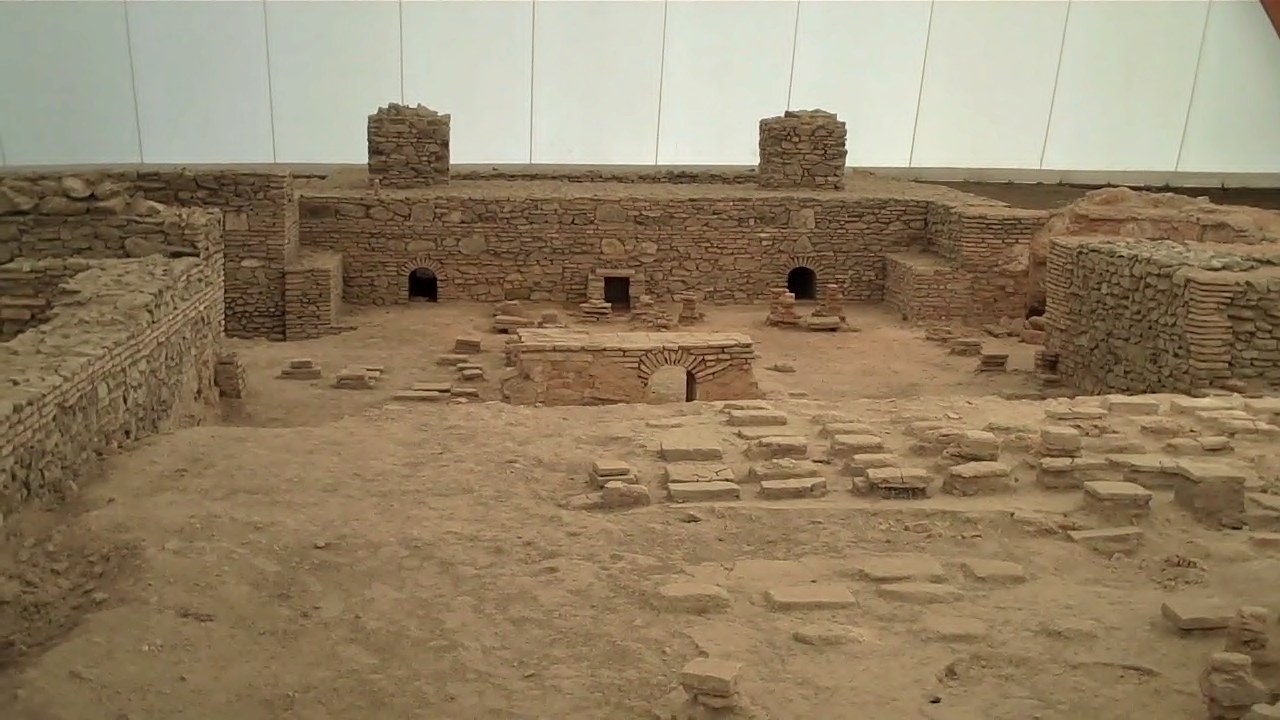
We are at Viminacium, one of many Roman towns and fortress in Serbia, not far from the capital city Belgrade. It covers a huge area and some of it is still undiscovered due to the presence of the nearby power plant which produces 20% of Serbia's energy. The government is trying to buy land still owned by the local people to stop the theft of artefacts that are uncovered after heavy rain.

Large numbers of lamps, bricks, paving tiles, rings and coins have been uncovered and exhibited either at the Museum in Pozarevac or the Museum in Belgrade. The Viminacium complex is building their own museum too at the moment.

The site has beautiful tombs decorated with frescoes whose colour was still bright and with mixed pagan and Christian symbolism. Tomb G5517 has a Christogram in a double floral garland and this is known as a Constantine Cross, after the first Roman Emperor to convert to Christianity. Tomb G2624 has animals and flowers and is clearly pagan, thus proving that Christians and Pagans were sometimes buried in the same cemetery.

Serbia has the largest number of Roman emperors born outside of Italy – 17 altogether, among them  Constantine I and Justinian I. The tourist board has put together a project to combine visits to all the major Roman excavations on Serbian soil, called Itinerarium Romanum Serbiae. It will incorporate Sirmium, today known as Sremska Mitrovica, Singindunum which is Belgrade, Viminacium or Stari Kostolac, combined with visits to the forts of Nis, Kostol and Karats. The itinerary also includes visits to the imperial residences at Gamzigrad and the UNESCO site, Šarkamen, Mediana and Iustiniana Prima .

2013 will see the 1,700 anniversary of the Edict of Milan by which Emperor Constantine legalised Christianity throughout the Roman Empire, and celebrations will take place in the city of his birth, Nis. A historic moment is planned when the Pope and the Patriarch of the Orthodox Church meet formally for the very first time.

For more information about travelling in Serbia please check our website or Email Us.  

A Night at the Museum in Belgrade, Serbia


For the eighth year in a row Belgrade is organising a Museum Night! This will take place on the 14 May 2011. Contrary to the movie “Night at the Museum” where Ben Stiller discovers that an ancient curse causes the animals and exhibits on display to come to life and wreak havoc, Museum Night in Belgrade is more havoc but in the sense that all these people who never had the time or money to go to a museum suddenly decide to go. The opening hours of the museums are 6pm-2am, and the best thing is that you buy one entry ticket for the price of RSD350 (approx. 3.5 EURO) and the ticket is valid for all museums and events open that night! Even public transport is free of charge with a museum ticket.
In Belgrade there will 95 events at 67 locations scattered around the city, and 58 other towns and cities in Serbia will host similar events. In order to see as much as possible you would need to plan and prepare, but the best way to start is at the official website of the Museum night - the only problem is that the site is in Serbian but at least with Latin script rather than Cyrillic! http://www.nocmuzeja.rs/
Expect a lot of crowds but not the regular ones like the usual strikers on the streets asking for their jobs back, but happy crowds, running from one part of the city to another and in passing exchanging tips on where to go and what to see. This is an excellent opportunity to find out more and learn about little secrets in this city with a uniquely fascinating history. The last time I went on a Museum Night stroll in Belgrade I visited the Bank Museum which I didn’t even know existed even though I was born in the city. We had a fantastic time learning about money in Serbia since the Tsar Dusan, the first Emperor of Serbia, whose coinage was on display.
 Except for the unusual opening times at the standard museums such as Konak of Kneginja Ljubica, Art Museum, Natural Museum, Jewish Historical Museum etc, there are some exhibitions open just for this night, Museum night.
At the Kalemegdan Fortress near the impressive Military Museum boys will be able to see a workshop for forging iron swords and try their skills at making a sword themselves. Not far from them, the girls will have unique opportunity to see the art of making hats and to try and make one too.
The Faculty of Philosophy will have an open door and show how old Romans played social games, The Danube Adventurethe National Tourism Board of Serbia has an interactive exhibition called Danube Adventure where you can see how to cycle along the Danube river on the famous Eurovelo 6 route which goes all the way to the Black Sea. At the Educational Museum there is the possibility to learn about the process of making wine in Serbia. At the Villa of King Peter Karadjordjevic you will be able to see for the first time hundreds blue trainof photos of the king, his family, contemporaries and events. Brazil will be represented at the night of Museums at Kalemegdan Fortress with different dances, concerts and readings of Brazilian stories. There will be an excellent opportunity for train spotters at the Railway Museum with an exhibition of the Blue Train which was Tito’s official train and carried a huge number of foreign dignitaries such as Indira Ghandi and Queen Elizabeth. For the first time the exhibition will display the original features from this period: busts and paintings, official stationery, models, emblems, charters, badges and schedules of the Blue Train.
Lots to see and experience but not enough time to squeeze everything into 8 hours. Definitely an excellent opportunity to get to know Belgrade and Serbia!
For more information what to see and do in Serbia please email Tara@ReadyClickAndGo.com

Where is Europe?


A few years ago we went for a long weekend to Morocco and as a  responsible traveller we arranged insurance which clearly stated that Morocco is in Europe. Then we went to Slovenia which was referred as the most progressive country of Eastern Europe. Of course the Slovenians were not impressed being positioned in Eastern Europe when they are clearly ’an Alpine country bordering Italy and Austria ’.
Here in the UK they refer to Europe as a continent. “We are going to the continent for a holiday” means two weeks in Provence.
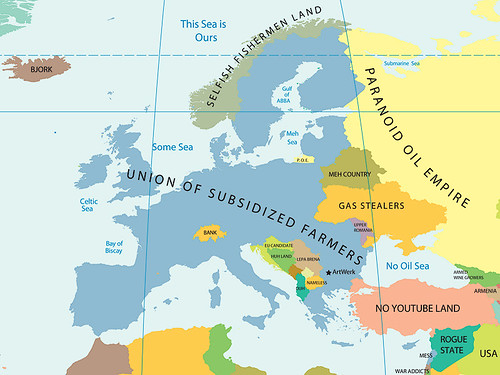
So where are the borders of Europe? And does a single Europe exist? Or are there   Eastern, Western, Scandinavian, Balkan, Alpine, Central, South Eastern Europe …And this divide is valid only if you are coming from the Western Hemisphere. If you are flying from China then Eastern Europe is Germany, Holland, UK, France!
The most significant eastern border of Europe was established by the Swedish geographer and cartographer von Strahlenberg  as lying in the Ural Mountains. But that border is not in accordance with the EC divide which has members of the EC, non members of the EC and prospective candidates. As someone who comes from Eastern Europe, from a country which is not a member of the EC and a long way from  even becoming a candidate,  I find it very difficult to explain to people when they ask me where I come from. Sometimes I make a terrible mistake saying “the former Yugoslavia” and we end up talking about the Iron Curtain in Europe when there was a clear divide based on political systems. We were communist and the rest of Europe capitalist. Then in accordance with political preferences the United States and Western Europe established the NATO alliance and later the Soviet Union and Eastern Europe established the Warsaw Pact. I felt for the Germans being divided into East and West but also divided into NATO and the Warsaw pact. Then after forty four years Germany was reunited, after the symbolic fall of the Berlin Wall in 1989, and the maps of Eastern Europe were redrawn once more.
I think only the Europeans define themselves so much by division - mainly by geography but usually by wars  - while the rest of the world see us just as  ’ Europe’ .There are various descriptions of Europe’s boundaries, some some sources include territories that other sources do not include in Europe. 
For example, Cyprus is close to Turkey but is often considered part of Europe and is a member state of the EU. For Western Europeans, Eastern Europe is Bulgaria but for the Bulgarians themselves Turkey is Eastern Europe as far as the Bosporus Straits, but for Western Europe Turkey is not Europe at all. Lots of people think that Malta belongs to Africa. Would you say Finland was in Europe or Scandinavia? Or is Bosnia in the Balkans or Europe? When you search for your next holiday please have a look at which countries  are really ‘Europe’.  The travel industry is the biggest culprit for dividing Europe. Usually by price.
What do you think where are they – the borders of Europe? My email is Tara@ReadyClcickAndGo.com or leave comment here.
 

What to see in Belgrade


Am I the only Yugoslavian who hasn’t visited the Flower House, the resting place of the last President of Yugoslavia, Tito? I was born and brought up under liberal communism and I should be grateful to him – Tito. But I was never confirmed into Tito’s youth organisation, the Pioneers, which had an initiation ritual which was almost religious, albeit without the live animals but a kid’s soul instead, and with no mention of God, only Tito. This was when you had to confirm your commitment to your homeland, brotherhood and unity and fellow Pioneers, but a few weeks before my big day I got appendicitis and was hospitalised and never again got the chance to declare my love for my country or see the communist light. When he died I didn’t feel obliged to pay my respects to his casket or visit his tomb, even though I was constantly pestered to. I just didn’t feel the need. Then 20 years later, after exploring the EC in depth by living in various countries, a friend decided to come to Belgrade and visit Tito’s tomb. Of course the guide was me. I wanted to see if I was still Yugoslavian.
Tito’s tomb is in the Museum of the 25th May, part of the Museum of the History of Yugoslavia, and is very close to Partisan Stadium, and at the beginning of December it was almost empty except for the coachload of visitors from Slovenia - the highest number of foreign tourists to Serbia are from Slovenia. Is this guilt or a desire to learn what they were part of for 46 years?
ReadyClickAndGo, Serbia The old Museum is now a large exhibition space and its current exhibition is Polish and Russian official and dissident art, called “Behind the Iron Curtain”. It is divided into 3 sections, WWII, the rebuilding of the war-torn country and happy people, and this last section had numerous portraits – farmers in the field, the naval officer with a huge medal, an ordinary, good looking woman in a blue suit with the communist star proudly pinned over her heart. The most significant work is from 1936 and shows Stalin’s name in big red letters with Lenin’s face reflecting back in the red paint. 
After the exhibition we went to see the “Flower House” and Tito’s tomb. The complex of the buildings used by Tito during his life is now his resting place. There are lots of angry people who think that Tito’s resting place should move from Belgrade to Croatia as he was Croatian and also because he damaged Serbia by dividing her into three parts, Inner Serbia, the Autonomous Region of Kosovo and the Autonomous Region of Vojvodina. There is even someone so resentful that they keep trying to sell his tomb on the Serbian version of Ebay!
His tomb is very simple, plain white marble with his name and dates of birth and death engraved in gold. Sceptics are commenting on the absence of the red star, a symbol of communism, convinced that he was a Mason, although no one proved this yet. His tomb is positioned so that he can see the biggest working Church in Europe, St Sava. I am sure Tito didn’t want a view over a church especially when proclaiming that “Religion is the opium of the people” and went on to close down so many Orthodox churches, prosecuting priests and abolishing all religious gatherings. 
ReadyClickAndGo, SerbiaHis office is filled with Ching dynasty furniture, generously given by a Slovenian family which made me wonder about the  combination of the two. But of course there are lots of unanswered questions about the communist time. There is a huge collection of batons which were used on mass relay races throughout Yugoslavia when all sorts of people would run – housewives, pioneers, workers, peasants, reformed political dissidents – and at the end present their batons to Tito at the Partisan Stadium on his birthday, 25th May. There would be a huge ceremony and half the schools and Universities in the country were closed. Did I go to any? No. My mum keeps saying that I am an antisocial person. 
Next to the Flower House there is a permanent exhibition of official gifts presented to Tito. Some are very bizarre such as the face towel, handmade and inscribed with “to dear Tito”. The art is beautiful but purpose wrong. I stayed the longest in front of a sword from XVII century brought to Sarajevo by the great great great grandchildren of Mehmed Pasa Sokolovic who got it from the Sultan of the Ottoman Empire. The sword is beautifully worked with Arabic inscriptions described by Orhan Pamuk in his book “My Name is Red”. There a good display of national customs from different parts of the former Yugoslavia, and it was nice to see them today when we are all dressed the same jeans and leather jackets. All the exhibits have an English description and the staff are very helpful. The atmosphere is very laid back and very organised. I bought a great souvenir, Tito’s cookery book with recipes for the meals served to his famous guests, Kennedy, Richard Burton and Elizabeth Taylor, Gina Lolobridga, Kissenger and so on. 
We spent a good three hours at the museum altogether.  Entry tickets are 300 dinars, about £2.50.
ReadyClickAndGo offers private day trips and sightseeing excursions throughout Serbia, with your own English-speaking local guide, car and driver. A private city tour of Belgrade with a private car, driver and English-speaking local guide is £65 per person.
For more information please email Tara@ReadyClickAndGo.com or check our website at www.ReadyClickAndGo.com
Tara

A Serbians second home, the kafana


Kafana Albanija in Belgrade, Serbia 1933
The English have pubs, the French their cafes, Italians their ice cream parlours, the Greek Tavernas and we, Serbians, have Kafanas or second homes as we spend more time there than at home. The word Kafana is derived from the Turkish kahvehane (“coffee house”) which is in turn derived from the Persian term qahveh-khaneh and the first kafana in Serbia was opened by the Turks in the part of Belgrade called Dorcol, in 1522, at the start of their 400 year occupation of the Balkans.
Kafanas are a cult for Serbian people and any self-respecting Serb has kafana or two. Maybe three depending on what your average Serbian citizen needs one for at any given time in his social life.In the past a kafana always had red or blue checked tablecloths and tin ashtrays but today many kafanas masquerade as restaurants or cafes or even clubs, but at heart they are simply a kafana. So there is a kafana for a social gathering which includes lots of alcohol interspersed with breaks for tasty food, loud live folk music, with smashed glases on the floor and dancing on the tables.
There are kafanas near the office where all the office games and intrigue take place, always described however as ‘business meetings’.  There are a few kafanas which are always full even though there is never any live music or good food, but which still live on their reputation as a haunt for long-ago heroes or intellectuals who would freely discuss politics during the communist era when there was no reliable information except what could be gleaned in such places – nowadays people still go there to be seen and to gossip. And there is a new breed of family kafanas where there is no live music only a kids’ garden in the back, and very good food!
You know you have succeeded in life if the waiter of your kafana knows you by name, your favourite table has a reserved sign on it just for you and when you get your favourite drink served before you even take your jacket off. If you are well known and short of money you can drink and eat free and pay when you get money.  You waiter is your best friend and confidant as he knows where you are and never tells anybody. Not even your other half.
Skadarlija, Belgrade, Serbia
If you are coming to Belgrade you must explore a bohemian part of town called Skadarlija where live music and good food last until the early hours. The most famous kafana here is Tri Sesira (the three hats) but there are many others, such as the Dva Jelena ( Two stags ), Ima Dana and the famous Znak Pitanja (the question mark, the kafana with no name). This is in an old traditional house, typically Serbian, very rustic, with laid-back service and good food.
A small tip for foreigners going to a kafana with Serbians – your host will never allow you to pay for dinner or drinks, so don’t even try to pay. Just raise your glass, look at your host and shout cheers – ZIVELI!!!!! 
For more information about Serbia and private dat trips in Serbia please email Tara@ReadyClickAndGo.com or check our website at http://www.readyclickandgo.com/

How to make Serbia's favourite dish - Sarma?

In one of my previous post I explained how to make a sauerkraut in order to make a Serbian favorite dish - Sarma. Today you will find a recipe how to make her Highness of winter dishes - sarma. If you need any help or explanation please email me at Tara@ReadyClickAndGo.com  
You need the following ingredients:
5 large leaves of sauerkraut, rinsed and drained
1 pound minced pork or beef
1 teaspoon salt
1 teaspoon of ground paprika
1/2 teaspoon of black pepper
2 large eggs, well beaten
1/2 cup of uncooked rice, rinsed
3 slices of smoked bacon
1/2 pint of tomato sauce 
6 tablespoons of cooking oil
4 tablespoons of flour
Gently fry in some oil the minced pork or beef, adding the salt, ground paprika, eggs and rice, and stir. Once it's browned, place a large spoonful of the mixture into each of the sauerkraut leaves, wrap them into rolls tucking the ends of the leaves in, and place in a cooking pot. My mum usually covers the bottom of the pot with cabbage leaves first, to prevent the sarma burning and disintigrating. Once all the stuffed leaves are placed neatly, cover them with a mixture of the smoked ham which we usually cut into small pieces fried with the tomato sauce for a juicy taste. Put any remaining cabbage over the sarma and add enough warm water to cover the rolls. Bring it to boil and then reduce the heat, cover and cook gently for 2 hours, adding a paste of oil and flour to thicken the sauce if necessary half way through.
  
Sarma freezes well and can be served hot or cold.

Enjoy.
For more information about Serbia please email Tara@ReadyClickAndGo.com or visit our website at www.ReadyClickAndGo.com


Oplenac, Serbia


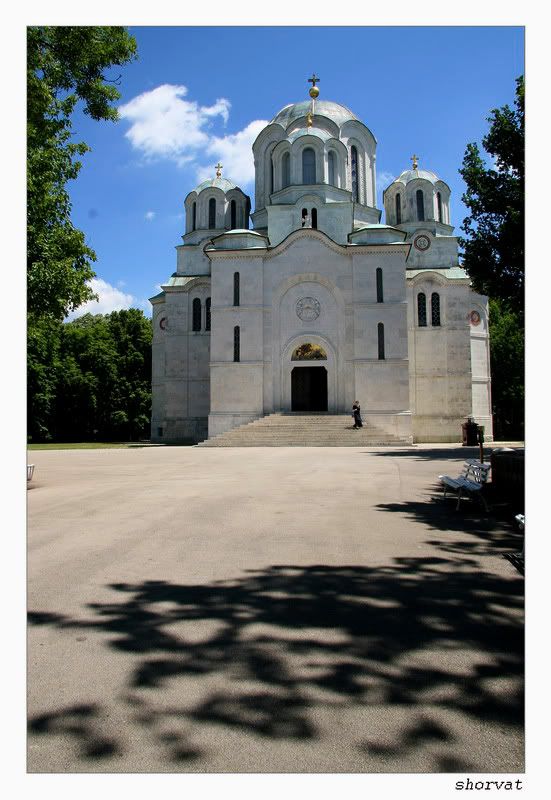
An unusually warm day in November in Belgrade gave me the excuse to take a day trip to a small town in central Serbia, called Topola. I had always wanted to go and visit this charming town to see its church of St George which is the mausoleum of the Serbian Royal Family, Karadjordjevic. The five-domed church was built in the style known as Serbian–Byzantium, a sort of oriental gothic style, between 1910 and 1930, by King Peter I who was a grandson of the founder of the royal family who led the Serbs in an uprising against the Ottoman Empire that had controlled the Balkans for centuries. The revolution was successful, the Ottomans were booted out and in 1811 Karadjordje was confirmed as the lawful ruler of Serbia and his heirs after him. At St George's Church four of Serbia's kings and 18 members of the Karadjordje dynasty are buried in the crypt, their tombs made of onyx from Decani in Kosovo, and representing the pearl of Serbia's cultural and historical heritage.
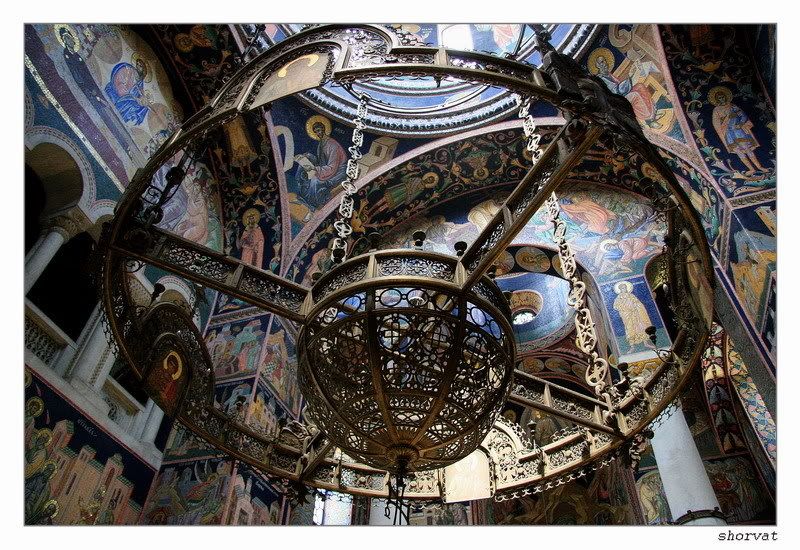
The most important characteristic of church is the mosaic that covers much of the interior walls, made from Murano glass from Venice. I loved the huge candelabra which is made of melted weapons from the Battle of Kajmackalan in WWI and in the shape of the medieval crown of Serbia but upside down, symbolising Serbia's mourning at the loss of their country at the Battle of Kosovo in 1389.
Entry tickets are 300 Serbian Dinars which is around GBP2.5 or Euro 3. The price includes entrance to St George's Church (the curator is happy to give you lots of information in English), King Peter's house (a small summer villa built in 1912 for his own use and today a museum), the villa of King Alexander I and Queen Mary (closed to visitors at the moment) and entry to the tower and Church of Our Blessed Lady of Karadjordje Town, dating from 1811-1813.
If you have time you may visit the royal winery at the foot of Oplenac Hill. Every year in Topola since 1963, on the 2nd weekend in October, the traditional Oplenac Vintage takes place.
By car from Belgrade is around 3 hours each way, through picturesque countryside. But please be aware that the roads are potholed and road signs are very poor in Serbia – most of the time there are no signs at all, and if you are lucky enough to find any they are in Cyrillic. But on the upside, there are lots of traditional Serbian restaurants known as "kafana" which serve wonderfully hearty, freshly cooked food and the average price is a modest GBP15 for a three course meal including drinks. We recommend MB Kafana.

For more information about a Private Day Trip to Oplenac and Topola or any place in Serbia please email Tara@ReadyClickAndGo.com or visit our website at www.ReadyClickAndGo.com


The National Dish of Serbia - Sarma

If you want to eat healthy wholesome meat dishes, the best time to visit Serbia is the winter – the amount of tempting homemade food makes you fat just by looking at it!

One of the most popular winter dishes is stuffed cabbage leaves and I am sure you
Zemun food market and that the best cabbage is found at Bajlonova market.I do accompany my mother on occasional trips and get dazzled by the neat displays of bright colours, and get carried away and buy a bit of everything which really annoys my mum - she buys food not for the colour but for what she is cooking that day.

Choosing the right cabbages is an art in itself. They must be round, firm, with big healthy leaves, which can peel away easily – check that by pulling off one of the outside leaves, and if it breaks, it means the cabbage won't work for wrapping around the meat. At home cut out the core of the cabbages and fill the cavities

with salt. Yes, salt. Then you lay the salt-filled cabbages neatly in a wooden barrel (which gives a much better taste than if you use a plastic bucket), filling the spaces between them with cabbage quarters, and put it somewhere cold like the cellar. Fill the barrel with water almost to the top, bearing in mind that the volume of the cabbages will shrink, then put a heavy object on the top to press the cabbages. My mum uses a 'house rock' she brought back from the mountain near Arandjelovac during one of our weekend trips when we were kids and she has only ever used it in the preparation of cabbage – it is her domestic treasure!

Leave the cabbages to soak and press in the wooden barrel for a week, keeping the rock clean and cleaning the foam that gathers on the top of the water every day. Top up the water level and add more salt – generally, use 2kg of salt for every 30kg of cabbage! After a week of this, your cabbage leaves will be ready to stuff – the recipe will be in my next blog!

For more information check our website at www.ReadyClickAndGo.com or email Tara@ReadyClickAndGo.com


The Chapel of Peace, Sremski Karlovci, Serbia


Around 50 miles north of the capital city of Serbia, Belgrade, on the slopes of the Fruska Gora National Park and on the right bank of the Danube River, is one of Serbia’s most important spiritual and cultural towns, Sremski Karlovci. Since 1713, this place has been the seat of the Serbian Archbishops so don’t be surprised if among the sea of tourists from different countries you come across a group of black-robed Orthodox priests come to visit the ornate 19th century Archbishop’s Residence. Especially famous for its good wines and honey (which both you can taste at various establishments around the town), its local dessert kuglof (a fruity, spiced cake), its beautiful baroque architecture and very nice inhabitants, Sremski Karlovci is also well known for its contribution to history books since it was here that the term ‘round table’ was first used when describing the signing of a peace agreement. The first peace agreement to be so described was signed here in 1699 between the Turkish, Polish, Venetians and Austrians, and it was thrashed out around a round table on a site a little way out of the town which is commemorated by a circular building, the Chapel of Peace, that has four doors, one for each party to the treaty. 
According to the caretaker of the Chapel of Peace, a well-informed and talkative chap, this unusual building is beginning to be popular with visitors again since the EC decided to invest in its reconstruction on the condition that it opened its fourth door behind the altar, the so-called Turkish Door. When we came to visit the Chapel of Peace there was no one to greet us except strong winds and closed doors. We, like history-hungry peeping toms, looked through the windows and keyholes trying to catch a glimpse of the past. Suddenly a tall guy appeared in front of us telling us to go to the opposite side of building and he would open the door for us. It seemed strange that he did not tell us to enter the building with him, but later he explained that he only carries the key for the Turkish door as most visitors are from Turkey – as we were Christian we could only enter the building by one of the other doors. Inside there is an altar which covers the Turkish door (the chapel was built by the Catholics of the town), and there used to be an organ but it was damaged by the rather careless builders who restored the building recently. The windows are distinctive – on the first floor they are made in the shape of the Dutch flag and on the ground floor they represent the Union Jack – both England and Holland were the ‘international peacekeepers’ overseeing the peace agreement of 1699. The whole building is painted yellow inside and out, the staircase to the first floor is original but covered in paint stains and refurbishment is ongoing.
The Chapel of Peace is a witness to a significant historic event, but nowadays is sadly underused – it would make a wonderful space for concerts and exhibitions, and is definitely well worth the stroll from the town centre along the quiet residential streets.
For more information please email Tara@ReadyClickAndGo.com


Eco Lodge in Serbia

We all talk about saving the planet but how many of us really do something? We occasionally recycle. Only because our councils imposes such a huge fines that we have to. We still curse supermarkets for such a waste of wrapping and packaging on food but we still drive to the supermarkets to get the same food. We still fly out of convenience and pay for our “sins” by signing away a certain amount of money on the booking form to ‘offset’ our flight. And still feeling guilty we try hard to get an ‘eco-friendly’ five star hotel in the middle of nowhere.
My last holiday, just in between the BA strikes and the volcano eruption, was spent in a National Park in Serbia. Yes, they do have national parks. We looked for ‘eco’, comfort, nature, history, a spa and we came across “Ranch Platan” which is located on one hectare of the Fruska Gora National Park at 280 m above sea level. We booked our apartments by email as the option of taking payment over the internet in Serbia is not possible yet. The very friendly email “voice” was happy for us to pay on arrival. Now how many of you booked a hotel without paying at least a deposit not to mention the full amount four weeks before arrival ? Here at Ranch Platan they go to basic hospitality rule – trust!
The friendly voice behind the whole idea of an ‘eco ranch’ in Serbia belongs to a lady called Vesna who greeted us personally on arrival and even then she wasn’t bothered about money as her first and utmost motivation is her guest! Nothing exists on that ranch except YOU and YOUR HOLIDAY!
She took us to our well-decorated cottage, one of six, each with its own entrance, balcony, fireplace, kitchen, bathroom, and loft with double bed. But something they don’t  advertise and it is included as free of charge is fresh air, peace, tranquillity, views. Yes you do have WiFi as well if you are that desperate on your holiday.
The ranch doesn’t include breakfast but your cottage does have cooking facilities. You do get basic ingredients like coffee, tea, sugar, salt, oil, sweets and a bottle of local wine. You can bring a bag of pasta and some eggs. You don’t need more as most days you spend sightseeing around the 17 nearby monasteries, and there are big maps of the region on display at the Ranch. The owners, very friendly city couple who decided to change way of life and bought a land few years ago, are on standby in the house which is located at the Ranch itself for any information regarding area.
If you are tired and just want to chill out go and see Vesna’s husband, a pleasant, quiet man with a huge movie collection. Once you are in the lodge you can light a fire in the kamin  and enjoy tranquillity of the place.  Or just walk above your lodge to nearby view point for amazing country side views and ozone saturated fresh air. Also  there is a spa in  the village of Vrdnik and the treatments are cheap – a basic massage is around £15 per person and the spa is only 600m from Ranch Platan.  You can also play basketball, volleyball, table tennis or badminton on a little court on the edge of the ranch, or simply walk to the Tower of Vrdnik, a Roman castle about 4km away – the doctors at the Spa recommend it!
After few days in this amazing place you will come back invigorated and wishing you could stay longer.
Please check their website at http://rancplatan.com/smestajen.htm even you are not planning to go there. This is a new breed of hotels, new “Eco” Serbia which you need to learn about.

For more information about Serbia please email Tara@ReadyClickAndGo.com

Travel Guide to Serbia


Getting there 

The main airport in Serbia is in the capital city, Belgrade, and it is named after the Serbian scientist Nicola Tesla. It’s avery small airport and quite close to the city centre. Once you are out of the building don’t let yourself be persuaded by cab drivers to take you to the city centre for 20 euros as that is not a bargain. As the airport is very close to the town (25 min from New Belgrade and 35 min from the old town, depending from the traffic over the Danube) you can get on the shuttle bus service provided by the national airline, still called Yugoslavian Airlines (JAT) or on one of the local buses (LASTA). The JAT shuttle will take you to the city centre and drop you in front of the Hotel Slavija, and the buses will take you to the train and bus stations which are not far from each other. The cheapest option is bus number 95 which stops close to the domestic departures building, but it does take ages to get into town, driving through all the new suburbs of Zemuna and New Belgrade – interesting though! Tickets can be bought before you catch the bus from the newsagent at the airport, and they cost 90 dinars which is less then £1.  
You can also fly to Nis, a quaint town in the south that is rapidly gaining popularity.  
Trains connect Serbia to all quarters of Europe, the main routes being Budapest, Vienna, Thessalonika, Bucharest, Sofia and Skopje and with the possible exception of routes to the East, they are comfortable, punctual and clean, and overnight trains are a good way of arriving. Trains within Serbia however are a little older and a bit shabby.
The Danube flows right through the centre of Belgrade and many river cruises on the way to the Black Sea from Budapest moor overnight here. It’s an expensive way to get to Belgrade, but you do have time to see Belgrade’s main street and impressive fortress.

Getting around 

Very difficult! Most maps, sign posts and other important information is written in the Cyrillic alphabet rather than the western Latin alphabet, and this is the official script of Serbia. You might find it useful to familiarise yourself with Cyrillic letters in order to be able to spell out words – names especially
The main public transport in Belgrade are the buses which are very frequent. There are thousands of taxis too, they vary in size, comfort and price – sometimes you get a little old Yugoslavian banger, sometimes a much more modern car! You can hail taxis in the street or go to a taxi rank, or call one (or get someone local to call one for you)
Beotaxi, 011/970 (White cab)
Žuti taxi, 011/9802 (Yellow cab)
Pink taxi, 011/9803 (Pink cab)
Hiring a car is very easy but driving on your own around Serbia could be a tricky business especially if you are a first time visitor. Driving is on the right, roads could be bumpy, traffic signs are posted in the official cyrillic letters and fellow drivers are not very patient. If you can’t afford to pay for someone to drive you around then travel by bus. 

Where to stay? 

In Belgrade I would recommend the Moscva Hotel which has a very long history (it opened in 1908), is very conveniently located in the city centre and has welcomed such distinguished guests as Albert Einstein and his Serbian wife, Mileva. Another hotel with a good location is the Balkan Hotel, not far from the Moscva.
Be aware that prices are higher but the standards not as good as in four or five star hotels in Western Europe. If you are going outside Belgrade I would suggest you stay in small inns which are affordable and professionally run. This Easter I am staying in one very close to the National Park of Fruska Gora., where there is a spa and a few beautiful old monasteries to visit.
Spa hotels are usually too expensive for the level of comfort they offer. The rooms are old fashioned and the hotels themselves usually a little unkempt as there has been not enough money for the government to invest in them (they are mostly state-run). However, the staff are always lovely!

National holidays 

There are too many holidays for the western soul! The number of official holidays comes from the fact that the old communist ones are still kept plus there are several new ones added since those days – so they represent the turmoil Serbia has been through in the last 20 years. 
January 1 – 2 (New Year’s Day), January 7 (Eastern Orthodox Christmas), January 14 (National Holiday (Orthodox New Year), February 15 (Constitution Day), 2 Apr Orthodox Good Friday, 5 Apr Orthodox Easter Monday, May 1 – 2 (Labour Day). 

Working holdays 

January 27 (Saint Sava’s Day), 9 May Victory Day, 28 Jun St Vitus’ Day, 31 December New Year Eve. 

Local time 

Central European Time Zone  GMT+1 

Visa

You may not need visa but you need to register with the Police. Registration is done automatically by hotel staff upon check-in, however if you are staying with friends in a private dwelling, you must register your presence with the police in the district in which you are staying.

Religion 

Orthodox Christianity is the major religion, the Serbian Orthodox Church became autonomous in 1219. Other important religions are Islam, Catholicism and Judaism. 

What is Serbia famous for? 

Hospitality – regardless of the hardship Serbians have been through in recent times guests are always very welcome. And always welcomed with open arms. 
Spas – the Republic of Serbia is rich in thermal mineral springs whose waters, depending on their chemical make-up, temperature and other properties, make it possible to treat and cure almost any illness for which spas are recommended. 
Monasteries – medieval orthodox monasteries such Studenica, Manasija, Žiča, Ravanica are an excellent opportunity to see part of Serbian history. If you are interested in art, there are excellent fresco masterpieces, especially the Beli Anđeo (White Angel) fresco in Mileseva monastery.
NightlifeBelgrade is one big night club from 10pm until the early morning, especially during the summer time when most of the bars are open on the banks of rivers Danube and Sava. Drink domestic beers as the bars don’t stock a huge amount of foreign beers and they often run out of them. Try the national drink, rakija (raki) which is usually made of plums and is 40% alcohol. Older people swear by its medical attributes.
Festivals – Visit EXIT festival  that is happening in the beginning of July, in Novi Sad, on Petrovaradin fortress. The EXIT festival came into being in the year 2000 as an act of rebellion against the regime of Slobodan Milosevic, that had for years been keeping Serbia out of touch with the outside. The Belgrade Beer Festival, takes place at Ušće in Belgrade every August. Anotehr famous Serbian Festival the Guca trumpet festival also known as the Dragacevo Assembly is an annual brass band festival held in the town of Guča, near the city of Čačak, a three-hour bus journey from Belgrade.

What to eat? 

The main dishes are based on meat, usually pork. There are some vegetarian dishes available, and it’s vegetarian heaven in the weeks before the Orthodox Christmas or Easter when Serbians fast, or eat no meat.
  • Gibanica – filo pastry pie with spinach and cheese or just cheese (like spanakopita or tiropita in Greece)
  • Pasulj – beans, a national speciality, often cooked for a long time and delicious with cured meat.
  • Prebranac – cooked and roasted beans with various spices and vegetables. Completely meat-free
  • Punjene Paprike – stuffed peppers
  • Roštilj– various meats grilled on an open fire, charcoal grilled. 
  • Paprikas – stew with paprika, usually made with chicken
  • Gulas – stew with paprika with beef
  • Sarma – cabbage rolls, similar to dolmades but made with sauerkraut instead of vine leaves
  • Riblja čorba – Fish soup using freshwater fish, very good at the barge restaurants along the Danube and Sava.
  • Proja – a type of corn bread with white cheese, and a national speciality.
And don’t forget to try domestic product – rakija – ( raki) which is usually made of plums and has 40% of alcohol. Older population swears by it’s medical attributes.

Do not 

Talk about war. Especially the recent one. If you have to – talk about WWI and WWII. If you are gay do not show affection publicly – it is still a rarity here. 
If you need more information about travelling in Serbia please email Tara@ReadyClickAndGo.com or check our website at http://www.ReadyClickAndGo.com/